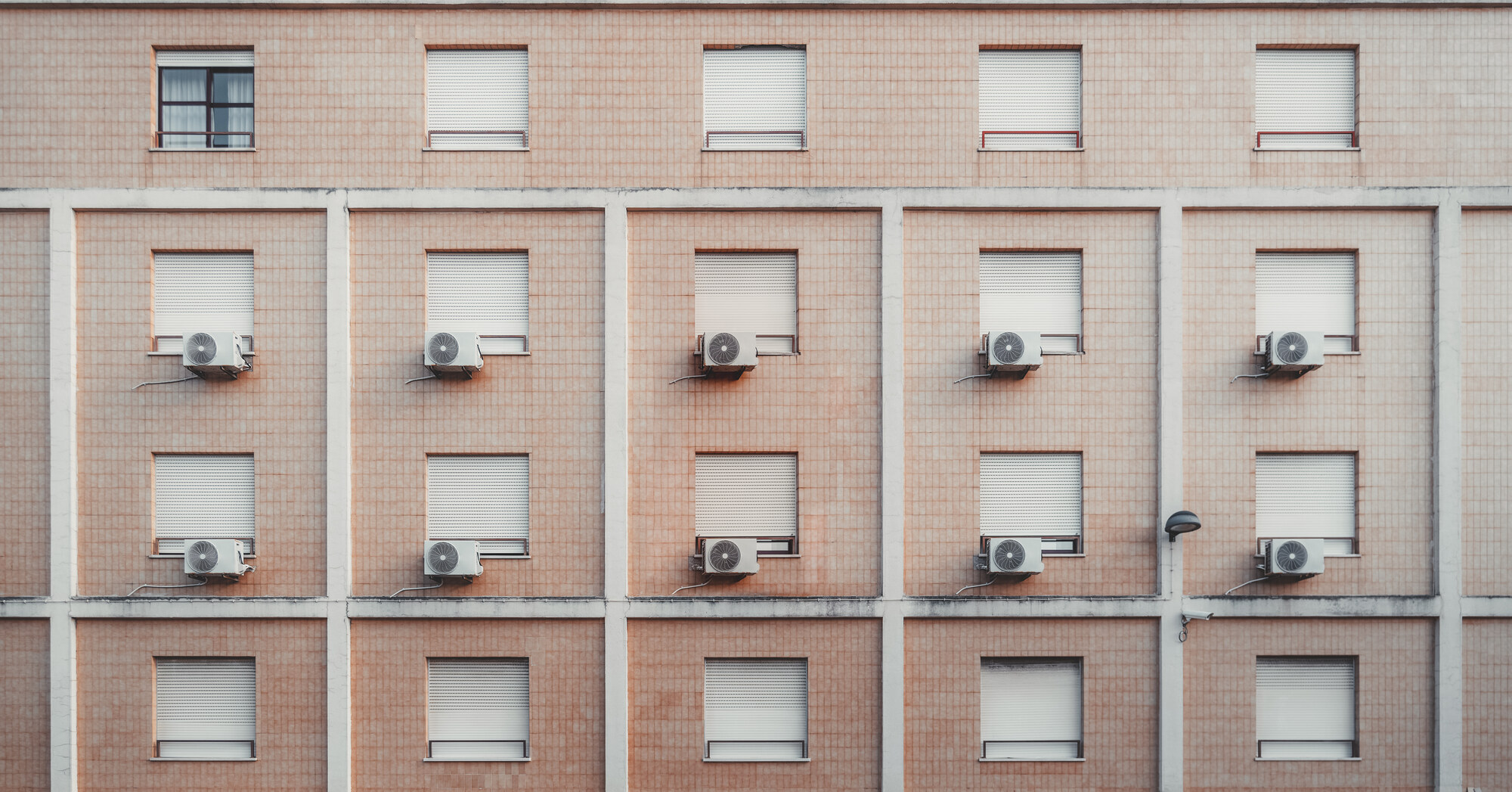
The owner of a second-floor flat in Corralejo wants three things before next summer: glass panels to close the terrace against the wind, an awning over what is left of it, and an air-conditioning unit whose outdoor half has to go somewhere. All three are, as he sees it, in his flat. All three touch something that is not only his: the façade. The Horizontal Property Act lets an owner do almost anything inside his walls and almost nothing to the outside of them, and since 2013 it has named the terrace enclosure in so many words. This piece reads the rule as it stands in October 2026: where the line runs, the majority each kind of work needs, what the Supreme Court has said about air-conditioning units and about works the community «put up with for years», how long the community has to react, and the town-hall side of the same works.
The line: inside your walls, and everything else
The rule is article 7.1. An owner may alter the architectural elements, installations and services of his flat cuando no menoscabe o altere la seguridad del edificio, su estructura general, su configuración o estado exteriores, o perjudique los derechos de otro propietario, when it does not impair or alter the safety of the building, its general structure, its exterior configuration or state, or harm the rights of another owner, and he must tell whoever represents the community before the works begin. The second sentence is shorter: En el resto del inmueble no podrá realizar alteración alguna, in the rest of the building he may make no alteration at all.
«The rest of the building» is larger than it looks from the sofa. The Civil Code counts among the common elements the façades, con los revestimientos exteriores de terrazas, balcones y ventanas, incluyendo su imagen o configuración, with the outer faces of terraces, balconies and windows, their image or configuration included (article 396), and roofs, walls and patios are on the same list, even where they are for one owner's private use. The Supreme Court has drawn the line strictly. In ruling 164/2014, of 4 April 2014, an owner had repainted the surrounds of her windows in a different colour shortly after the community painted the whole façade; the Court held that the community's authorisation is needed not only when structure or safety are touched, because it is enough that the change shows en la configuración estética o estado exterior que presente la fachada del edificio, in the aesthetic configuration or exterior state of the building's façade. In ruling 502/2025, of 27 March 2025, a heather screen fixed on a common dividing wall in Menorca had to come down: it changed the look of the complex and cut a neighbour's view of the sea, and the argument that it was «a minimal work» did not save it.
The table: work, majority, permit
| Work |
What the community must do |
Town-hall side |
| Works inside the flat that touch neither the structure nor anything outside |
No vote; notice to the president or the administrator beforehand |
Depends on the work |
| Glazing or closing a terrace |
Three fifths of the owners and of the quotas, unless the statutes already allow it |
Prior communication for one terrace; a licence when it is a project for the whole façade |
| An awning |
The model and colour the community has agreed; another model is a change to the exterior |
Prior communication, as an exterior work |
| The outdoor unit of an air conditioner on a façade or patio wall |
The community's authorisation; the courts are flexible where the building offers no other place |
Prior communication, as an exterior work |
| Solar panels on a private terrace |
A rule of its own: one third |
Prior communication |
The right-hand column is the Canary rule read in general terms, and each town hall's plan can add conditions of its own; both are explained further down.
Closing the terrace: three fifths, and who is counted
Until 2013 the Act said nothing specific about terraces, and the courts treated an enclosure as an alteration of a common element that needed every owner's consent. Since June 2013 the enclosure is among the works that require three fifths of all the owners, who must also hold three fifths of the quotas, and since 29 December 2023 the rule sits in article 17.4: la construcción de nuevas plantas y cualquier otra alteración de la estructura o fábrica del edificio, incluyendo el cerramiento de las terrazas o la modificación de las cosas comunes, the construction of new floors and any other alteration of the structure or fabric of the building, including the enclosure of terraces or the modification of the common things.
Three fifths is easier than unanimity, but the count is stricter than in most votes. In ordinary resolutions the owners who were not at the meeting and do not object within thirty days are counted as votes in favour. The Act switches that rule off en los casos en los que la modificación o reforma se haga para aprovechamiento privativo, where the modification or alteration is made for private benefit (article 17.8). An enclosure that benefits one flat needs real yes votes from three fifths of the whole community, which in a building where half the owners live abroad means proxies collected before the meeting, not silence after it.
Two things can make the vote unnecessary or easier. The statutes of many developments authorise enclosures in advance, to a given design; then the design is the limit, and whatever goes beyond it needs its own consent. Ruling 909/2021, of 22 December 2021, shows the difference: the community had authorised closing terraces with aluminium frames, but an owner had also demolished the walls between her terraces and the rooms behind them, and that had never been approved. The glazing stayed and the walls had to be rebuilt, because el art. 7 de la LPH impide las alteraciones en la configuración exterior de edificio sin la preceptiva autorización de la comunidad, article 7 of the Act prevents alterations to the exterior configuration of the building without the community's mandatory authorisation. And a community can decide once for everybody: a model of enclosure approved by three fifths, with its drawing attached to the minutes, lets each owner build to that model without a new vote.
Air conditioning: flexibility, with limits
No article of the Act mentions air conditioning. The Supreme Court's line, summed up in ruling 453/2016, of 1 July 2016, is that the installation of these units, even where they affect common elements, ha sido enjuiciada con un cierto margen de flexibilidad para permitir la puesta al día de viviendas que en el momento de su construcción no pudieron adaptarse a las mejoras tecnológicas, has been judged with a certain margin of flexibility, to allow homes that could not have these improvements when they were built to be brought up to date. Flexibility is not a licence. Whether a unit alters the common elements is decided case by case: deben tenerse en cuenta las circunstancias de cada caso, entre las que se incluye que se hayan realizado obras de perforación, the circumstances of each case must be taken into account, among them whether the wall has been drilled.
In the 2016 case the units came down. The building had been delivered with a pre-installation for air conditioning in every flat, so nobody needed the outside wall, and the wall in question faced a shared courtyard, furnished and planted for people to sit in, that looked like a main façade. The appellants had asked the Court to change its case law so that the units would be allowed whenever certain conditions were met; the Court declined. For an owner the practical order is therefore this: use the place the statutes or the meeting have designated, be it the roof, a patio or the floor of the terrace behind the parapet; where there is none, ask before drilling; and remember that a unit which drips or hums over a neighbour's bedroom is also a matter for the house rules on noise.
One question is new. Since March 2026 the one-third rule of article 17.1 covers private systems that use renewable energy incluyendo la aerotermia y geotermia, including aerothermal and geothermal energy, and an ordinary split unit is technically an air-source heat pump. Whether that brings a domestic air conditioner under the one-third rule is something no court has yet decided; our guide to energy works and the one-third rule explains the rule, which is also the one that governs solar panels on a private terrace.
«It has been there for years»: tolerance is not consent
The most common defence of an unauthorised work is time: the neighbours saw it, nobody complained, so they agreed. The Supreme Court accepts tacit consent only when it is unequivocal. In ruling 1006/2025, of 25 June 2025, about a patio that the owner of the ground-floor premises had roofed over two decades earlier, it repeated that no cabe equiparar el simple conocimiento con el consentimiento, ni el silencio como equivalente a manifestación positiva de voluntad, mere knowledge cannot be equated with consent, nor silence with a positive declaration of will. Consent has to follow from conclusive acts, and what counts is how obvious the works were to all the owners and how the community behaved. In that case the meetings had protested year after year, and the Court ordered the patio handed back to the community and restored to its original state.
The second defence is the neighbour who did the same. In the ruling of 2014 the owner pointed to other terraces closed and other units hung without permission; the Court answered that the comparison no exime de la necesaria autorización, does not release anyone from the necessary authorisation. And the ruling of 2021 adds two points that matter in practice: any owner, not only the president, can go to court for the community's benefit to have a common element restored, and consent cannot be presumed on a matter the meeting was never allowed to discuss.
How long the community has
The Act sets no period for these claims, and the answer the courts give surprises most owners. In ruling 534/2026, of 9 April 2026, the Supreme Court recalled its plenary doctrine of 2016: the action by which a community demands that a common element be restored to its previous state, against the owner who benefits from the alteration, es de carácter real y por tanto el plazo de prescripción aplicable a las mismas es el de treinta años, is a real action and the limitation period that applies to it is therefore thirty years. In that case only twenty-seven years had been proved since a storage room was built on a common roof terrace, so the claim could not be declared time-barred. The patio ruling of 2025 adds that whoever relies on the lapse of time has to prove it, and that doubt counts against him.
Two consequences follow. The action is not the «cessation» procedure of article 7.2, which is for forbidden or disturbing activities and starts with a formal demand by the president; it is an ordinary claim to put the building back as it was. And it follows the flat, not the person: it is brought against whoever owns it today. A buyer of a flat with a closed terrace or a unit on the façade should ask for the minute or the statute clause that authorised it, because «it was like that when I bought» is not, on its own, an answer to the claim.
The town hall is a second permission
The community's consent and the planning title are separate, and neither replaces the other. The Act itself says so: enclosures of terraces and changes to the common things Estarán sujetas al régimen de autorización administrativa que corresponda, are subject to whatever administrative authorisation applies (article 10.3). In the Canary Islands the regional land law, Ley 4/2017, sends exterior works on a building that is not listed to a prior communication, with no licence, salvo que se refieran a la modificación general de fachada o al acristalamiento de terrazas existentes mediante un proyecto conjunto de fachada, unless they consist of a general modification of the façade or the glazing of existing terraces through a joint façade project (article 332.1.b); for those, and for las de modificación general de la fachada o el acristalamiento de terrazas existentes afectante al conjunto de la fachada, works of general modification of the façade or the glazing of existing terraces that affects the façade as a whole, a licence is required (article 330.1.f).
Read together, the two articles put one owner's glazing, awning or outdoor unit under a prior communication and a building-wide project under a licence. That is the regional frame only. The municipal plan decides whether a closed terrace counts as built area, and a town hall may have rules on colours and materials, so the question goes to the municipal technical office before the aluminium is ordered. Our guide to works on the roof and their permits explains how the two titles work.
A checklist before ordering anything
- Read the statutes and the last minutes. A model of enclosure or awning, or a place for the units, may already be agreed.
- Ask in writing, with a drawing. Say what, where, in which material and colour, and send it to the president or the administrator before the works.
- Get the vote counted properly. Three fifths of all owners and quotas for an enclosure, with proxies from those who cannot attend; silence does not count in your favour.
- Have the model attached to the minutes. It protects you, and it tells the next owner what is allowed.
- Go to the town hall. File the prior communication, or ask for the licence, before the installer arrives.
- Keep the papers for the day you sell. The buyer's adviser will ask for them.
What we do in the communities we administer
In the buildings we manage in Corralejo, Caleta de Fuste and the south, a request to close a terrace, hang a unit or change an awning reaches us through the incidents section of the owner portal, with photos. We check it against the statutes and the models already agreed, put it on the agenda of the next meeting when it needs a vote, and send the proxy form with the convocation so that owners abroad are counted. The minutes and the approved model then stay in the portal with the rest of the community's documents, under the same login. Owners who want their community run that way can read what we do for owners who live abroad and ask for a quote.
Common questions
Do I need permission to glaze my terrace?
Yes, unless the statutes of your community already authorise it. The Act requires the favourable vote of three fifths of all the owners holding three fifths of the quotas (article 17.4), and because the work is for your private benefit the owners who stay silent are not counted in favour. You also need the town hall's title: a prior communication for a single terrace, a licence when the whole façade is redesigned.
Can the community make me remove an air-conditioning unit that has been on the façade for years?
It can ask a court to order it, and time alone does not protect you: the action to restore a common element lasts thirty years, and tolerance is not consent. The courts do judge these units with some flexibility where the building offers no other place for them and nobody is harmed, so the outcome depends on the façade, the fixing and the alternatives.
My neighbours closed their terraces without asking. Can I do the same?
No. The Supreme Court has held that pointing to other unauthorised works does not release an owner from asking for authorisation. If several terraces are already closed, the useful step is to ask the meeting to approve a single model for the building.
I am buying a flat with a closed terrace. What should I check?
Ask for the clause of the statutes or the minute of the meeting that authorised the enclosure, and for the town-hall paper. A claim to restore the façade is brought against the current owner, whoever did the work, and it can be brought for thirty years.