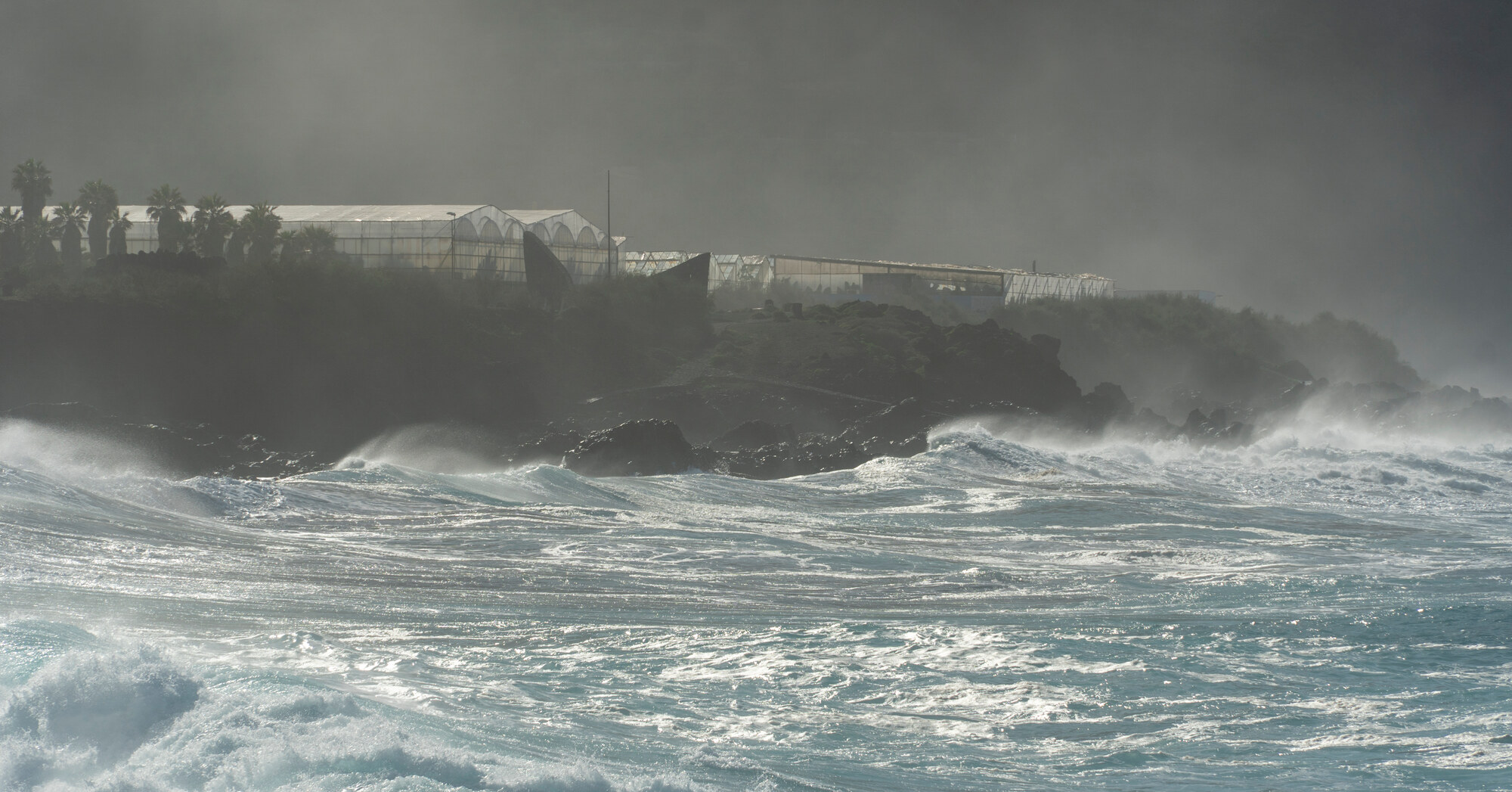
When a storm tears a pergola off a roof terrace in Corralejo or pushes the sea through a garden wall in Caleta de Fuste, three different payers may stand behind the repair, and which one answers depends on a number most owners have never heard: 120 kilometres an hour. Above it, and for floods and the sea, a public body called the Consorcio de Compensación de Seguros pays, on the terms of the community's own policy and without a deductible. Below it, the community's insurer pays, if the policy's wind and rain clause is met. And where the cause is a blocked drain or a roof nobody maintained, the community pays itself. This piece sorts storm damage into those three boxes, as the rules stand in October 2026: the regulation on extraordinary risks, the Consorcio's statute and its own guidance to claimants, the insurance contract law, the Horizontal Property Act and two community policy wordings read clause by clause. Then it follows one storm through one building on this island, cause by cause and invoice by invoice.
Three payers: the insurer, the Consorcio and the community itself
Spanish insurance splits weather in two. The insurance contract law says that an insurer does not cover war ni los derivados de riesgos extraordinarios sobre las personas y los bienes, salvo pacto en contrario, nor the damage that comes from extraordinary risks to persons and property, unless otherwise agreed. Those extraordinary risks go to the Consorcio, which every policyholder funds through a small surcharge on the premium; we explained that surcharge and what a community policy should contain in our guide to the community's insurance. The Consorcio then covers los mismos bienes o personas, así como las mismas sumas aseguradas que se hayan establecido en las pólizas de seguro, the same property and the same insured sums that the policy sets. It does not insure anything by itself: no policy, no Consorcio.
Two myths are worth clearing before the detail. The first is that the Government has to declare a disaster. The Consorcio says the opposite in its own words: Es posible que el siniestro afecte sólo a un asegurado, teniendo pleno derecho a la indemnización, the event may affect a single insured, who is fully entitled to compensation, and no official declaration of a catastrophe zone is needed. The second is that a storm is always the Consorcio's. Most are not: an ordinary winter gale and an ordinary downpour stay with the community's insurer or with nobody.
| Cause of the damage |
Who pays |
Where the claim goes |
| Wind with gusts above 120 km/h, or a tornado |
The Consorcio |
The community's insurer, which pays and recovers from the Consorcio |
| Wind below 120 km/h |
The community's insurer, if the policy's wind clause is met |
The community's insurer |
| The sea breaking on the coast |
The Consorcio |
The Consorcio |
| Flooding of the ground by rain or overflowing watercourses |
The Consorcio |
The Consorcio |
| Rain on the roof, the terraces, the drains or the patios |
The community's insurer, if the policy's rain clause is met |
The community's insurer |
| A blocked drain, a worn membrane, a lack of maintenance |
The community, from its own funds |
Nobody: it is a repair, not a claim |
What counts as extraordinary: 120 km/h, the flood and the sea
The regulation lists the natural events the Consorcio covers: earthquakes and seaquakes, extraordinary floods, volcanic eruptions, the atypical cyclonic storm and falling meteorites. For a building in Fuerteventura three of them matter.
Wind is extraordinary only at a precise speed. The regulation defines Vientos extraordinarios, definidos como aquellos que presenten rachas que superen los 120 km por hora, extraordinary winds as those with gusts above 120 km an hour, and a gust as el mayor valor de la velocidad del viento, sostenida durante un intervalo de tres segundos, the highest wind speed sustained over three seconds. The figure was 135 until October 2011, and an old policy booklet may still print it; the one in force is 120. The owner does not have to prove the wind: the Consorcio obtains the data from the state weather agency, which draws the affected area municipality by municipality.
A flood is extraordinary when the ground itself is under water: the flooding of the land by rain, by thaw or by rivers and natural watercourses that leave their beds. The same definition adds the sea, así como los embates de mar en las costas, as well as the sea breaking on the coast, and the Consorcio's own guidance goes further: Asimismo se incluye el embate de mar en la costa, aunque no haya anegamiento, the battering of the sea on the coast is included even where nothing is flooded. For the seafront complexes of this island that sentence is the most valuable line in the regulation.
What the definition leaves out is just as precise. A flood is not ni la lluvia caída directamente sobre el riesgo asegurado, o la recogida por su cubierta o azotea, su red de desagüe o sus patios, the rain that falls directly on the insured building or is collected by its roof or roof terrace, its drains or its patios. Water that comes in from above is not a flood for the Consorcio, however hard it rained.
What the Consorcio does not pay
The regulation's list of exclusions is short, and two of them decide most refusals in a community. The Consorcio does not pay the damage Los debidos a vicio o defecto propio de la cosa asegurada, o a su manifiesta falta de mantenimiento, due to a defect of the insured thing itself or to its manifest lack of maintenance, nor the damage due to the mere passage of time. Its guidance to claimants turns that into a plain list of what stays outside: wind without gusts above 120 km/h, hail, snow, and Goteras, filtraciones o humedades, leaks, seepage and damp.
Three conditions sit on the policy rather than on the weather. The policy must be alive and paid: the Consorcio compensates siempre que la póliza esté vigente en el momento de producirse los daños y el asegurado se encuentre al corriente del pago de la prima, provided the policy is in force when the damage occurs and the premium is up to date. A new policy must be seven days old before a natural event, a waiting period that does not apply when one policy replaces another without a gap. And a building insured for less than its value is paid in proportion, exactly as its own insurer would pay it.
Below the line: what the community's own policy covers
Under 120 km/h the answer is in the community's policy, and policies do not agree with each other. We read two published wordings for residential buildings. One works with numbers: it covers wind, rain, hail and snow siempre que se registre una precipitación superior a 40 litros por metro cuadrado y hora, provided rainfall above 40 litres per square metre per hour is recorded, and, for wind, velocidades superiores a 90 km/hora, speeds above 90 km an hour, proved by a certificate of the state weather agency or of the nearest official gauge. The other sets no figure: it covers rain, wind and hail when they se produzcan de forma anormal para el tiempo y lugar del que se trate, occur in a way that is abnormal for the time and the place, proved by official reports or, failing that, by evidence such as solid neighbouring buildings damaged by the same event.
Both models leave a gap, and the gap is where most arguments happen: wind of 70 km/h that lifts an awning, or steady rain of 25 litres an hour that finds a crack. That damage is neither extraordinary nor, in a numbers policy, covered. The state weather agency helps to settle the facts before the argument starts: it publishes, province by province and month by month, the stations where rainfall intensity or the maximum gust han superado los umbrales que se utilizan frecuentemente en la cobertura de seguros, exceeded the thresholds commonly used in insurance cover, and it issues certificates of past weather on request.
Saharan dust, the calima, is on neither list: the Consorcio's events do not include it, and one of the wordings we read expressly excludes sand or dust that enters through openings left unclosed. It is cleaning, and cleaning is a cost of the building.
Rain that enters through the roof is its own chapter, because a policy that covers the damage inside rarely covers the roof that let it in. We set out who pays for the repair in roof waterproofing as a community work and who pays for the damage in leaks between flats and from common elements.
The first seven days: who does what
The law gives the building's administrator the first move. The Horizontal Property Act charges the administrator with looking after the building, disponiendo las reparaciones y medidas que resulten urgentes, dando inmediata cuenta de ellas al presidente o, en su caso, a los propietarios, ordering the repairs and measures that are urgent and reporting them at once to the president or, where appropriate, to the owners. No meeting is needed to pump out a plant room or fence off a fallen parapet, and the owners' meeting is told afterwards: it must ser informada de las medidas urgentes adoptadas por el administrador, be informed of the urgent measures the administrator took. An owner who sees the damage first has a duty of their own: si advirtiere la necesidad de reparaciones urgentes deberá comunicarlo sin dilación al administrador, anyone who notices the need for urgent repairs must tell the administrator without delay.
- Make it safe and stop it getting worse. The insurance contract law says the insured deberán emplear los medios a su alcance para aminorar las consecuencias del siniestro, must use the means within reach to reduce the consequences of the loss, and puts the reasonable cost of doing so on the insurer.
- Photograph before anything is moved. The Consorcio asks that se conservarán los restos de los bienes dañados a disposición del perito, the remains of the damaged property be kept for its adjuster, and photographs taken where they cannot be.
- Keep every invoice of the emergency works. They are part of the claim.
- Notify within seven days. The law gives the insured dentro del plazo máximo de siete días de haberlo conocido, a maximum of seven days from learning of the loss. The Consorcio recommends the same seven days, aunque el Consorcio aceptará igualmente su solicitud si se presentara después del mencionado plazo, although it will accept a claim filed later.
- Send each claim to the right door. Flood and sea go to the Consorcio, by telephone on 900 222 665, or +34 952 367 042 from abroad, in Spanish, English or French, or on its website. Wind goes to the community's insurer whatever its speed: because the weather agency's report takes weeks, el Consorcio y las entidades aseguradoras han convenido que el asegurado dirija su solicitud a su entidad aseguradora, que se hará cargo de la tramitación y de la oportuna indemnización, the Consorcio and the insurers have agreed that the insured files with their own insurer, which handles the claim and pays, and settles with the Consorcio afterwards.
An owner abroad adds one call to that list: their own home insurer, for the furniture and belongings inside the flat, which a community policy does not cover. Our piece on leaving a flat empty explains who should hold the keys when that call has to be made from another country.
How the claim runs: the adjuster, no deductible, and who receives the money
The Consorcio values the damage with its own adjuster, sin que éste quede vinculado por las valoraciones que, en su caso, hubiese realizado la entidad aseguradora que cubriese los riesgos ordinarios, without being bound by any valuation the ordinary insurer may have made. A community that disagrees may appoint its own adjuster, at its own cost, and the two then work jointly.
There is no deductible. The ministerial order that fixes the Consorcio's deductible at 7 % of the damage adds that no se efectuará deducción alguna por franquicia a los daños que afecten a viviendas, a comunidades de propietarios de viviendas, no deductible is applied to damage to dwellings or to communities of owners of dwellings. The clean-up is paid too, within a limit: mud removal, demolition and the clearing and transport of debris count as damage to the building, and La indemnización conjunta por gastos complementarios quedará limitada al 4 por ciento de la suma asegurada, the joint compensation for these complementary costs is limited to 4 % of the insured sum.
When the policy covers the common elements and the flats' own fixed elements together, the money arrives in one payment. The Consorcio's adjuster values everything and el CCS paga el importe total a la propia Comunidad asegurada, the Consorcio pays the total to the insured community itself, so that ha de ser la Comunidad quien determine el reparto de la indemnización entre los copropietarios, it is for the community to decide how the compensation is shared among the co-owners. That is a decision for the owners' meeting, with the adjuster's breakdown on the table.
With the community's own insurer the clocks are the ordinary ones. The insurer must pay at least the minimum it may owe dentro de los cuarenta días, a partir de la recepción de la declaración del siniestro, within forty days of receiving the notice of loss; after three months without payment it owes interest; and the community's action against it expires en el término de dos años si se trata de seguro de daños, in two years in property insurance.
From Fuerteventura: one storm, three causes, three payers
A complex of 48 apartments on the seafront at Caleta de Fuste, its building insured for €6,000,000, takes a winter storm on the night of Tuesday 10 November 2026. The nearest official station records a maximum gust of 104 km/h. By morning three things have happened. The wind has torn the roofs off the pergolas and lifted a run of parapet coping: €18,400. The sea has broken over the promenade into the lower garden and filled the pool's plant room with seawater and mud: €41,700 of damage and €6,300 to clear the mud and the debris. And rain has come through a terrace drain that was blocked with leaves into two ground-floor flats: €3,900.
The administrator orders the pump-out, the fencing and a tarpaulin that morning, for €2,150, reports to the president, and photographs everything before the mud is touched. Both claims are filed on Thursday 12 November, inside the seven days.
The wind, at 104 km/h, is below the line: it is the insurer's, under a wind clause that starts at 90 km/h, less the policy's own deductible of €300, so €18,100. The sea is the Consorcio's: €41,700 plus €6,300, €48,000 in all, with no deductible, the clean-up far inside the 4 % limit, which on this policy is €240,000. The urgent works of €2,150 go into the claims as the cost of limiting the damage. The drain is nobody's but the community's: rain collected by a terrace is outside the Consorcio's flood, 104 km/h of wind did not block the drain, and the €3,900 is paid from the community's funds, to the two owners whose flats it damaged.
Had the gust been 126 km/h, the pergolas would have been the Consorcio's too, and the community would still have filed that claim with its insurer.
What we do in the communities we administer
In the buildings we manage in Corralejo, Caleta de Fuste and the south, a storm warning starts a routine rather than a meeting. We have the drains and roof outlets checked before the season, because a blocked drain is the one cause no insurer pays for. After the storm we order the urgent measures the Act puts on the administrator, open the incident with photographs so that owners abroad can see what happened to their building, and file each claim with the right payer inside the seven days, with the policy, the premium receipt and the invoices of the emergency works. At the next owners' meeting the measures are reported, the adjuster's breakdown is presented and the split of the compensation is put to the vote. Owners who want that done for their building can read what our community administration covers and ask for a quote with the number of dwellings and the name of the current insurer.
Common questions
I am abroad and the storm damaged my flat. Who do I call?
Two people. The administrator, without delay, because the Horizontal Property Act obliges every owner to report the need for urgent repairs and because the community's claim for the building starts there. And your own home insurer, for the contents and anything else your own policy covers. If the cause was a flood or the sea, the Consorcio's call centre takes the claim in English or French on +34 952 367 042 and asks for the policy, the damaged property and a bank account for the transfer.
Does the Government have to declare a catastrophe zone before the Consorcio pays?
No. The Consorcio's cover is automatic once one of the listed events has occurred, and its own guidance says that the loss may affect a single insured, who is fully entitled to compensation, without any official declaration. What it does need is a policy in force, with the premium paid, that is at least seven days old.
Our community has no insurance. Does the Consorcio still pay for the building?
No. The Consorcio compensates on the terms of a policy and only where there is one, so an uninsured building has no claim against it, whatever the wind speed. The repair is then a mandatory conservation work that the owners pay by quota through a levy. Neither state law nor Canary law obliges a community here to insure the building, which is exactly why the question has to be asked before the storm.
The insurer says the wind never reached the speed in the policy. What can the community do?
Check the fact before arguing the clause. The state weather agency publishes the stations where the gust exceeded the thresholds used in insurance and certifies past weather on request; a policy that speaks of abnormal weather rather than a figure can also be met with evidence such as damage to solid neighbouring buildings. If the disagreement is about the amount, the insurance contract law gives each side an expert and, failing agreement, a third. The community has two years to bring its action.