Every membrane on the island has a date on it, whether anyone wrote it down or not. A bituminous sheet laid on a Corralejo roof in the nineties has spent thirty summers under a sun that ages asphalt faster than any manufacturer's chart allows for, thirty winters of wind-driven rain and a good many calima seasons filling its drains with dust. Our piece on leaks explained who pays when water finally comes through a ceiling. This one is about the roof itself: when a community is obliged to re-waterproof, who decides, how the bill is shared among owners — including the one who lives in Manchester — and what to demand from the contractor so that the next date on the membrane is a long way off.
The roof is common — even the terrace you sunbathe on
The Civil Code lists among the common elements of a building «the ground, the airspace, the foundations and the roofs» (Código Civil, art. 396). A roof does not stop being common because a top-floor owner has the exclusive use of the terrace laid on top of it: its structure and its waterproofing remain the community's, and the community repairs them and answers for the damage a failed membrane causes below — the Supreme Court settled the point in January 2024, in the case we told in the leaks piece. What is private is the surface the owner uses, and any damage caused by their own misuse. That single distinction decides who pays for a re-waterproofing before any meeting is called: everyone, by their share, not the owner who happens to walk on it.
When re-waterproofing is a duty, not a choice
The Horizontal Property Act separates two kinds of works, and the whole procedure follows from which one the roof falls into.
Conservation works are mandatory and need no prior vote. The Act makes obligatory, and exempts from any prior resolution of the owners' meeting, the «works necessary for the adequate maintenance and fulfilment of the duty of conservation of the building and its common services and installations, including in any case those necessary to satisfy the basic requirements of safety, habitability and universal accessibility» (Ley de Propiedad Horizontal, art. 10.1.a). A membrane that has reached the end of its life is a habitability question — watertightness is one of the basic requirements of every building (Ley de Ordenación de la Edificación, art. 3.1.c) — so renewing it is not something the community may decide to do; it is something the community must do. The meeting's role is narrower than owners often think: for mandatory works the resolution «is limited to the distribution of the corresponding derrama and the determination of the terms of its payment» (art. 10.2.a). No owner can vote the roof out of being repaired.
Improvements are optional and follow a different rule. New installations or improvements «not required for the adequate conservation, habitability, safety and accessibility of the building» need three-fifths of owners and quotas, and a dissenting owner is not bound when the installation share exceeds three months of ordinary fees (art. 17.4). Re-waterproofing is not that. Laying insulation on top of the new membrane, to cut the heat load on the flats below, is an energy-efficiency work with its own majority and its own cap — twelve months of ordinary fees after subsidies, by simple majority (art. 17.2) — and it is worth deciding at the same time, because the scaffolding and the crew are already there.
Where owners disagree on which kind of work it is, the Act sends the question back to the meeting, and lets the interested parties ask for arbitration or a technical opinion (art. 17.10). In practice the technical report that says «the membrane has failed» closes the argument before it starts.
Two organs act before any meeting. The administrator must «attend to the conservation and upkeep of the house, ordering the repairs and measures that are urgent» and report them at once to the president (art. 20.c) — which is how a roof that fails in November is patched in November. And the meeting «approves the budgets and the execution of all repair works on the property, ordinary or extraordinary, and is informed of the urgent measures taken by the administrator» (art. 14.c) — which is how the full renewal is decided for the following spring.
Who votes, and on what
The vote, then, is on the budget, the contractor and the derrama — not on whether to repair. Those resolutions pass by the ordinary majority: a majority of owners representing a majority of quotas at first call, and at second call a majority of those present holding more than half of the quotas present (art. 17.7). Owners who were duly called and did not attend are counted in favour unless they object in writing to the secretary within thirty natural days of being told of the resolution (art. 17.8), and a resolution validly adopted binds every owner (art. 17.9). An owner who thinks the resolution is unlawful or gravely harmful may challenge it in court — within three months, or one year if it is contrary to the law or the statutes — but only if they are up to date with their fees or deposit the debt first (art. 18), and the challenge does not stop the works unless a judge says so.
For the owner abroad the practical rules are the ones from our meeting guides: a proxy by signed writing (art. 15.1), a notified address in Spain for the convocation (art. 9.1.h), and the thirty-day window after the minutes arrive, which is the moment to object if you mean to. An owner in arrears attends but does not vote (art. 15.2).
How the derrama is split
Each owner contributes «according to the participation quota fixed in the title, or to what is specially established» (art. 9.1.e). For a roof that means by cuota de participación — the percentage on your deed — and not by floor, orientation or use: the ground-floor shop and the penthouse pay in proportion to their quotas, and the top-floor owner with the private terrace pays exactly their quota, no more, unless the community's statutes assign roof or terrace costs differently, which some older titles on the island do and which the administrator checks before drafting the derrama. The derrama's instalments attach to the flat like ordinary fees: the property answers for the unpaid share of the current year and the three previous ones (art. 9.1.e and 10.2.c), and a buyer inherits that liability — which is why the debt certificate a seller must produce at the notary shows what is owed, derramas included, as our fees and derramas guide explains.
Before the derrama comes the reserve fund. Every community must hold one, funded by quota, at no less than 10 % of its last ordinary budget, precisely «to attend to the conservation, repair and rehabilitation works of the property» (art. 9.1.f). It rarely pays for a whole roof, but it pays for the technical report, the first invoice and the urgent patch, and it lets the meeting spread the rest.
A worked example. A forty-unit building in Corralejo with an ordinary budget of €96,000 a year holds a reserve fund of at least €9,600. The technical report puts the full re-waterproofing of the roof and the two common terraces at €48,000. The meeting approves the budget, draws €8,000 from the fund and levies a derrama of €40,000 in four quarterly instalments. An owner with a 2.5 % quota pays €1,000 in total, €250 a quarter; the owner of the large penthouse with a 4 % quota pays €1,600, and the shop with 1.5 % pays €600. Nobody pays for the view.
What the works should contain
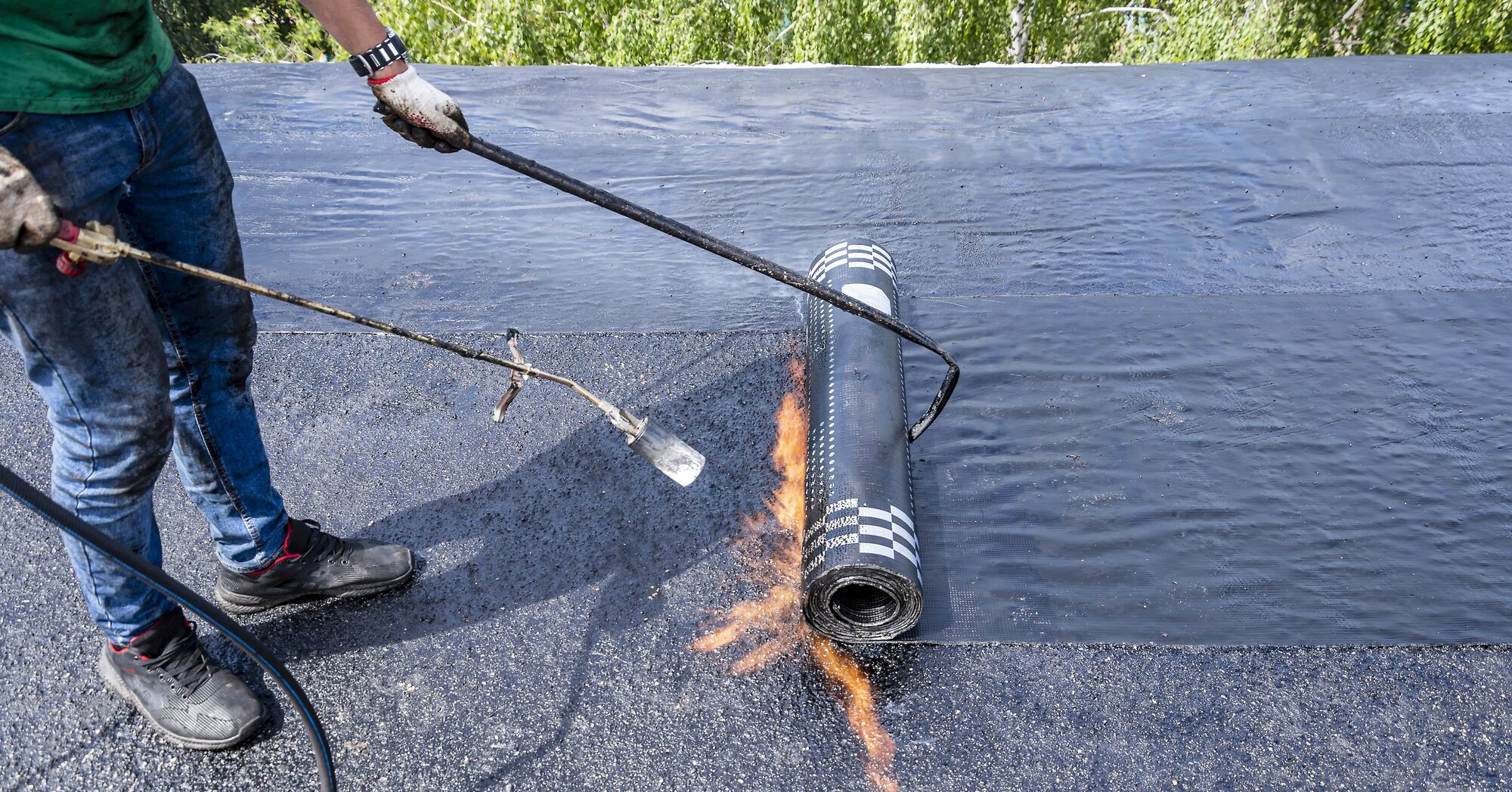
The technical yardstick is the Building Code's section on protection against damp — Código Técnico de la Edificación, DB-HS 1 — which sets what a roof must do rather than which product to use: a continuous waterproofing layer, falls that carry water to the drains, and the joints, upstands and outlets — the puntos singulares where nearly every leak starts — resolved so that the membrane does not tear where the roof meets a wall, a skylight or a drain. On a flat Canarian roof the usual answer is a torch-applied bituminous membrane or a liquid polyurethane system, laid on corrected falls, turned up the parapets, reinforced around every outlet, and finished with a protection layer — gravel, tiles or a reflective coating — because an unprotected membrane under the island's ultraviolet is the reason many roofs here fail in ten years instead of twenty.
Three practices of ours belong in every roof contract:
- A technical director. For works of this size we insist on an arquitecto técnico who writes the specification, compares the quotes on equal terms, supervises the execution and signs the completion. The permit is the director's job too: in the Canaries, conservation and rehabilitation works that add no volume and touch no listed building need only a comunicación previa to the town hall, not a licence (Ley 4/2017 del Suelo de Canarias, art. 332.1.a) — scaffolding that rests on the pavement is the one detail that can still call for a licence — and the communication is filed before the first roll is unrolled.
- Three comparable quotes, priced against the same specification, with the membrane's make and thickness, the treatment of the drains and parapets, the protection layer and the flood test named line by line. A quote that says «waterproofing of roof, lump sum» is not comparable with anything.
- A flood test before acceptance. The finished roof is flooded and left for a day before the community signs the reception. A membrane that passes it in September will pass the first storm in November.
The warranty to demand
The Building Act's famous warranties — ten years for structural defects, three for defects that compromise habitability, watertightness included, one for finishes (Ley de Ordenación de la Edificación, art. 17.1) — attach to building works within the Act's scope: new buildings and interventions that alter a building's configuration, which need a project (art. 2.2). A membrane renewal on an existing roof usually does not fall inside it, so the guarantee a community gets is the one it writes into the contract. Ours contain three things: a workmanship warranty of at least three years, mirroring the Act's habitability term, for defects in execution; the membrane manufacturer's system warranty, which for the main brands runs to ten years when the sheet is laid by an approved installer and the specification is followed — in writing, in the community's name, not the contractor's; and a retention of part of the price — the Act's own reference is 5 % of the works for the first year (art. 19.1.a) — released after the first rainy season has passed without a drop. The contractor's liability insurance is checked before signing, and the completion certificate, the flood-test record, the invoices and the warranties go into the community's technical file, where the next building inspection and the insurer's expert will look for them.
The island's calendar
A roof on Fuerteventura is planned against the weather, not the financial year. The rains that find the failed membranes arrive in the autumn and winter; the works themselves want the dry months, and a torch-applied membrane wants days without the strongest of the trade winds. The sequence that works for the communities we administer: the technical report in winter, when the leaks are visible; the decision at the ordinary meeting in spring, with the budget and the derrama; the contract and the permit before summer; the works in late summer; the flood test and the reception before the first autumn rain. An owner abroad is copied at every step, because the works will need access to private terraces — every owner must allow the repairs the building's service requires and let the community in for them, with a right to be compensated for any damage the works cause (art. 9.1.c and d) — and a locked terrace on a scheduled day costs the community a crew's wages.
Where we come in
Our administrators in Fuerteventura commission the technical report, put the budget and the derrama to the meeting in a form owners abroad can vote on by proxy, run the three quotes against one specification, hold the retention and the warranties in the community's name and keep the technical file the next inspection will ask for. See our community maintenance service, or ask for a quote.
Common questions
Can the owners' meeting refuse to re-waterproof a failing roof?
No. Works necessary for the conservation, safety and habitability of the building are mandatory under article 10.1.a of the Horizontal Property Act and need no prior resolution; the meeting only decides how the derrama is distributed and paid. An owner who disputes that the works are necessary may ask for a technical opinion, but the technical report on the membrane usually settles it.
I own the penthouse with the terrace. Do I pay more for the roof?
No. The roof and its waterproofing are common elements even where the terrace is for your private use, so you pay your ordinary participation quota like every other owner — unless the community's statutes assign roof costs differently. You pay alone only for damage caused by your own misuse of the terrace.
How is the cost shared if I am abroad and did not attend the meeting?
By your participation quota, like everyone else, and the resolution binds you whether or not you attended. If you were duly called and did not object in writing within thirty days of being told of the resolution, you are counted as having voted in favour. You may vote by proxy with a signed writing.
What warranty should the community get on the new membrane?
A written workmanship warranty of at least three years, the manufacturer's system warranty — commonly ten years when an approved installer follows the specification — issued in the community's name, and a retention of part of the price released after the first rainy season. The Building Act's ten-, three- and one-year warranties apply to works within its scope, which a membrane renewal usually is not, so the contract is where the guarantee lives.