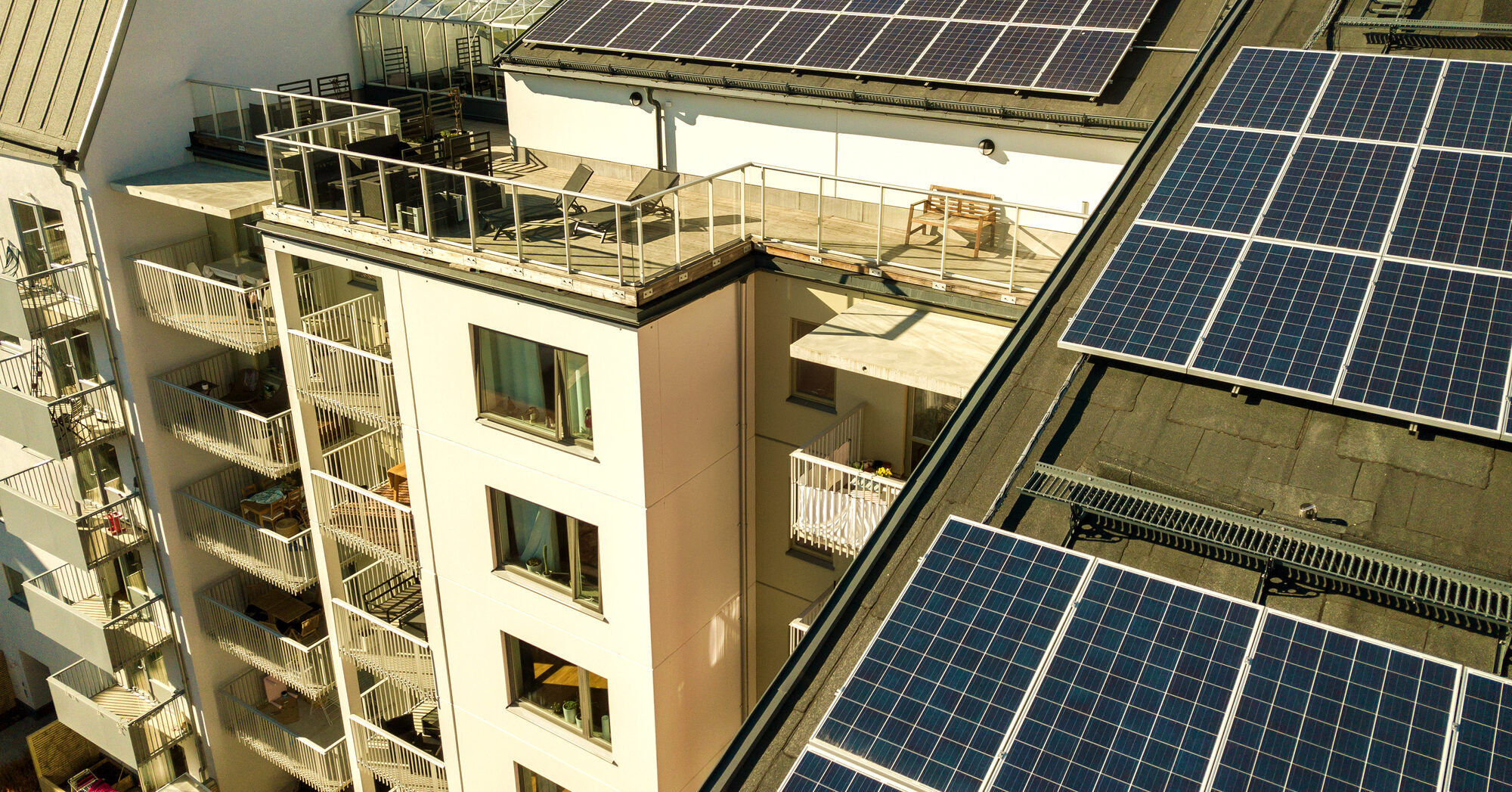
Two requests reached our desks this summer within a week of each other. In a block in Caleta de Fuste, eleven owners out of thirty-eight wanted photovoltaic panels on the roof to run the lifts, the pool pumps and the garage lighting, and asked whether they could go ahead without the rest. In Corralejo, a community of twenty-four wanted to replace the electric water heaters of the common areas with an aerothermal unit and pay for it out of the reserve fund, so that nobody received a levy. Both questions have answers in the Horizontal Property Act, and both answers changed in March 2026, when a decree written for an energy crisis in the Middle East rewrote one line of the Act, one line of the local taxes law and one provision of the income tax law in the same text. This piece reads the three majorities that govern energy works in a community, what the reserve fund may and may not pay for, the permit the island asks for, the subsidies that exist in September 2026 — as opposed to the ones that are still advertised — and a thirty-kilowatt roof worked both ways. Quotations are in Spanish with the reading in English.
Three works, three majorities
The Act does not have one rule for «energy works»; it has three, and the whole procedure depends on which one the project falls under.
The one-third rule. Article 17.1 covers the common telecommunications infrastructure and «la instalación de sistemas comunes o privativos, de aprovechamiento de energías renovables, incluyendo la aerotermia y geotermia, o de las infraestructuras necesarias para acceder a nuevos suministros energéticos colectivos» — the installation of common or private systems for the use of renewable energy, including aerothermal and geothermal, or of the infrastructure needed to reach new collective energy supplies. Such an installation «podrá ser acordada, a petición de cualquier propietario, por un tercio de los integrantes de la comunidad que representen, a su vez, un tercio de las cuotas de participación»: it may be resolved, at the request of any owner, by one third of the members holding one third of the quotas (Ley de Propiedad Horizontal, art. 17.1). The price of that low threshold is who pays, and we come to it below.
The simple majority with a cap. Article 17.2 covers «la realización de obras o actuaciones que contribuyan a la mejora de la eficiencia energética acreditables a través de certificado de eficiencia energética del edificio o la implantación de fuentes de energía renovable de uso común, incluyendo en su caso la modificación de la envolvente del edificio» — works that improve energy efficiency in a way the building's energy certificate can prove, or the installation of renewable sources for common use, including changes to the building's envelope — and, in the same sentence, the application for subsidies, loans or any financing to pay for them. All of it «requerirá el voto favorable de la mayoría simple de los propietarios, que, a su vez, representen la mayoría simple de las cuotas de participación, siempre que su importe repercutido anualmente, una vez descontadas las subvenciones o ayudas públicas y aplicada en su caso la financiación, no supere la cuantía de doce mensualidades ordinarias de gastos comunes»: a simple majority of owners and quotas, provided the annual cost, after public aid and any financing, does not exceed twelve monthly ordinary instalments. Then the sentence that matters to the owner who voted no: «El propietario disidente no tendrá el derecho reconocido en el apartado 4 de este artículo» — the dissenter has none of the right to stay out that improvements normally carry — and the cost is a general expense, shared by participation quota like the lift and the pool (art. 17.2).
The three-fifths rule. Equipment or systems «no recogidos en el apartado 1, que tengan por finalidad mejorar la eficiencia energética o hídrica del inmueble» — not covered by the one-third rule, whose purpose is to improve the building's energy or water efficiency — need three fifths of owners and quotas, and the resolution binds everyone; if the equipment serves private use, one third is enough and the one-third cost rule applies (art. 17.3). Replacing the pool pumps with variable-speed units, the lighting with LED and timers, the common water heater with a more efficient one of the same kind: none of that is a renewable source, so it lives here.
Everything else that is not required for conservation, habitability, safety or accessibility is an improvement under article 17.4: three fifths to approve, and a dissenting owner is not bound when the installation share exceeds three monthly ordinary fees (art. 17.4). A photovoltaic plant or a heat pump can be read as an improvement too; the Act's later and more specific rules are the ones a meeting should invoke, and the item on the agenda should say which. Where owners disagree about the nature of the works, the meeting decides, and the interested parties may ask for arbitration or a technical opinion (art. 17.10).
Our electric-vehicle piece walked the same three rules for chargers; this one is about the roof and the plant room.
The one-third rule after March 2026
The words «incluyendo la aerotermia y geotermia» have a short and instructive history. They were first written into article 17.1 by a decree of June 2025, which the Congress refused to validate in July, so the amendment was left without effect within a month; the consolidated text carries the note. They returned on 21 March 2026 in the Real Decreto-ley 7/2026, de 20 de marzo, the decree that approved the Government's response plan to the crisis in the Middle East, in force since 22 March 2026 and validated by the Congress on 26 March (Boletín Oficial del Estado of 28 March 2026). Aerothermal and geothermal heat pumps are now expressly renewable systems for the purposes of the one-third rule, which ends the argument a technical report used to have to win. Photovoltaic and solar thermal were never in doubt.
Four consequences follow from the wording, and every one of them matters to an owner who lives abroad.
- Any owner may put the item on the agenda. The rule opens with «a petición de cualquier propietario». A single owner can require the president to include the installation in the next meeting, and the resolution passes with a third of the members and a third of the quotas — not of those present, of the community.
- Only those who voted yes pay. «La comunidad no podrá repercutir el coste de la instalación o adaptación de dichas infraestructuras comunes, ni los derivados de su conservación y mantenimiento posterior, sobre aquellos propietarios que no hubieren votado expresamente en la Junta a favor del acuerdo»: the community cannot charge the installation, or its later upkeep, to owners who did not expressly vote in favour at the meeting. Under this rule the levy is not by quota across the building; it is shared among the yes-voters.
- Silence is not a yes. For most resolutions, an owner who was duly called and did not attend is counted in favour unless they object within thirty natural days (art. 17.8). The same paragraph excepts «los supuestos expresamente previstos en los que no se pueda repercutir el coste de los servicios a aquellos propietarios que no hubieren votado expresamente en la Junta a favor del acuerdo» — which is exactly this case. An owner in Manchester or Munich who wants a share of the roof must vote yes, in person or by a proxy with a signed writing (art. 15.1); an owner who says nothing is left out, and left unbilled.
- Latecomers pay their way in. An owner who later wants to use the installation «podrá autorizárseles siempre que abonen el importe que les hubiera correspondido, debidamente actualizado, aplicando el correspondiente interés legal»: they may be admitted on paying the share they would have paid, updated at the legal interest rate. The plant itself, once installed, «tendrá la consideración … de elemento común» — it is a common element, even though a minority paid for it (art. 17.1).
The one-third route, then, is the tool of a committed minority: quick, and paid for by those who chose it. The simple-majority route of article 17.2 is the tool of a community that wants the whole building in, at the price of a majority vote and the twelve-month cap. Both are lawful for the same set of panels; the difference is who ends up paying, and a well-drafted agenda item names the article before the vote.
What the reserve fund may pay for
Every community holds a reserve fund, and the Act says what it is for. Each owner must contribute, by quota, «a la dotación del fondo de reserva que existirá en la comunidad de propietarios para atender las obras de conservación, de reparación y de rehabilitación de la finca, la realización de las obras de accesibilidad recogidas en el artículo diez.1.b) de esta ley, así como la realización de las obras de accesibilidad y eficiencia energética recogidas en el artículo diecisiete.2 de esta ley» — the conservation, repair and rehabilitation works of the property, the accessibility works of article 10.1.b, and the accessibility and energy-efficiency works of article 17.2. The fund belongs to the community, «estará dotado con una cantidad que en ningún caso podrá ser inferior al 10 por ciento de su último presupuesto ordinario» — never less than 10 % of the last ordinary budget — and may also pay for a damage-insurance policy or a permanent maintenance contract (art. 9.1.f).
Read the list carefully, because it answers the Corralejo question. The energy works the fund may pay for are those of article 17.2: the works and the common renewable sources a simple majority approves for the whole community. A one-third resolution under article 17.1 is a different animal — its cost may not be charged to the owners who did not vote for it, and the fund is money every owner has contributed by quota; in our reading, paying a minority's installation from the common fund would do through the back door what the Act forbids through the front, and we do not draft it that way. What the fund does, in the communities we administer, is pay for the majority route: the aerothermal unit in the plant room approved by a majority, the panels approved for common services by a majority, and the technical fees and certificates that go with them.
Two practical limits. The 10 % is a floor, not a balance to spend: a community that draws the fund down below it must build it back in the next budget, so the meeting usually applies what sits above the floor and levies the rest. And the fund is real money in the community's account, not a line in a spreadsheet — our annual-accounts piece shows where to find it, and our fees and derramas guide explains how a levy attaches to your flat.
The permit on the island
A community that has voted for panels or a heat pump still has to tell the town hall, and here the Canary Islands are easier than the mainland write-ups suggest. The regional land law lists what needs only a comunicación previa — a prior communication, with no licence — and the list was written for this: «la implantación, en suelo urbano y urbanizable, de instalaciones de producción eléctrica a partir de fuentes renovables de potencia no superior a 100 Kw, asociadas a modalidades de suministro con autoconsumo»; «centralización o dotación de instalaciones energéticas comunes y de captadores solares u otras fuentes de energías renovables, en fachadas o cubiertas de las edificaciones existentes, que no supongan una modificación general de la fachada»; «realización de obras en zonas comunes de edificaciones que tengan por objeto lograr un uso más eficiente de energía eléctrica y suministro de agua»; and photovoltaic panels on the roofs of buildings, «hasta el 100 % de la superficie de la cubierta» — up to the whole roof — which may be complemented with solar thermal (Ley 4/2017 del Suelo de Canarias, art. 332.1, letters n, p, q and r). Thermal insulation of an existing building and bioclimatic devices on façades and roofs are on the same list (letters ñ and o).
Two things still need a licence: scaffolding or machinery that rests on the road, or on the pavement without leaving 1.20 metres of free passage (art. 330.1.p), and any general alteration of the façade. A change to the building's envelope for energy reasons — external insulation over the whole front, for instance — is also one of the works the Act itself subjects to administrative authorisation and to the consent of the owners affected (Ley de Propiedad Horizontal, art. 10.3.b). Ordinances differ from one town hall to the next on what the communication must attach; for anything on a roof we file it with the installer's project, the structural note on the roof's load and the same technical director we described for roof works, because a plant bolted through a membrane is a leak waiting for its first winter.
The subsidies that exist in September 2026
This is the section where most articles on the subject go wrong, because they list programmes that have closed. Here is the position as the official pages read on the date of publication.
- The State Housing Plan 2026–2030. The Real Decreto 326/2026, de 22 de abril, in force since 24 April 2026, carries an aid for the integral rehabilitation of residential buildings that communities of owners may apply for (art. 96.1.c). For habitability and sustainability works the aid reaches 65 % of the cost, up to €13,000 per dwelling, when the works cut the building's non-renewable primary energy consumption or its heating-and-cooling demand by 45 % or more, and 80 %, up to €20,500 per dwelling, from 60 % (annex II); partial works on the envelope may get up to 40 % and €7,500 per dwelling (art. 99.3.c). The building must have been finished before 2006, hold a Libro del Edificio Existente, remove any asbestos, and bring its envelope to the Building Code's values; fossil-fuel boilers are excluded (arts. 97 and 98). One condition is written for owners like ours and deserves the full quotation: the subsidy is shared among the dwellings «que sean domicilio habitual y permanente de las personas en ellas residentes. Aquellas viviendas que no sean domicilio habitual y permanente de sus residentes no participarán en el reparto de la subvención» (art. 97.f.2.ª) — a holiday flat or a second home is counted for the works and left out of the aid, and its owner pays their full share. Access is by regional calls (art. 100), the works have thirty-six months from the grant (art. 103), and the aid is paid after the works, against the before-and-after energy certificates (art. 102). At the date of publication the Canary Housing Agency lists no open call under this plan; its building-rehabilitation call under the previous European programme closed on 15 December 2023, and its page says so.
- The Canary self-consumption call. The regional government's order of 23 March 2025 (Boletín Oficial de Canarias of 10 April 2025) opened a non-competitive call for renewable generation, self-consumption and storage, funded by the European recovery instrument. Communities of owners were eligible, but on one condition: «solo serán subvencionables las instalaciones de autoconsumo colectivo» — only collective self-consumption installations, whose electricity can also feed other buildings within two kilometres, not a plant that serves the community's own meter alone. For applicants without an economic activity the tables put the maximum aid at €950.40 per kilowatt-peak of photovoltaic generation and €400 per kilowatt-hour of storage. Applications closed on 28 July 2025, after an extension, and the file is now in its justification phase. There is no open call for a community roof on the island as we write; whether the Government opens another is the Government's to say, and the meeting should not budget on it.
- The 60 % income-tax deduction, for residents. The same March 2026 decree rewrote the income-tax provision on energy works. Owners of dwellings in a predominantly residential building where energy-rehabilitation works are carried out until 31 December 2027 may deduct «el 60 por ciento de las cantidades satisfechas» — 60 % of what they paid — on a base of €5,000 a year, the excess carried forward for four years, up to a cumulative €15,000, provided the building's certificate after the works shows a 30 % cut in non-renewable primary energy or a class A or B rating, and the money was paid by card, transfer, cheque or bank deposit, net of any subsidy (Ley del IRPF, disposición adicional quincuagésima, apartado 3). The two smaller deductions for works inside a dwelling, 20 % and 40 %, run to 31 December 2026 (apartados 1 y 2). The provision had been extended by three decrees that the Congress later repealed; the March 2026 text is the one that stands, and the tax agency's own page still showed the old dates when we checked it. It is an income-tax deduction: a Spanish tax resident applies it in their annual return; a non-resident owner, who pays the non-resident tax on the same flat, has nothing equivalent.
- The Canary regional deduction, for residents. A Canary resident may also deduct 12 % of what they pay for energy-rehabilitation works in the home they own and live in — including their quota of works the community contracts, which the community certifies — on a base of €7,000 a year, within 10 % of the regional part of their tax, with the before-and-after certificates registered in the regional registry and no cash payments (Manual de Renta 2025, deducciones autonómicas de Canarias, apartado 10.5.19).
- The IBI relief. The same decree of March 2026 rewrote the local-taxes rule that lets a town hall grant up to 50 % off the property tax of buildings with approved systems that use solar or ambient energy — aerothermal and geothermal now expressly included. It is optional and needs the municipal ordinance; our sister piece on the island's six ordinances says which town halls have it and at what rate.
The honest summary for an owner abroad: in 2026 the money for a community roof on Fuerteventura comes from the owners, with a tax deduction for the residents among them, a possible IBI relief for everyone, and a subsidy only if a call opens before the contract is signed — and applications always go in before the works begin.
A worked example: a thirty-kilowatt roof in Caleta de Fuste
A building of forty flats with an ordinary budget of €96,000 a year — €8,000 a month for the whole community, €200 per flat on average — and a reserve fund of €12,000, above its €9,600 legal minimum. The technical report proposes a 30 kWp photovoltaic plant on the roof to feed the common meter: two lifts, the pool's filtration pumps, the garage and stairwell lighting, the pressure group. The quote is €39,000 installed, with the structural note, the communication to the town hall and the monitoring included; the installer's simulation, which we treat as a projection and not a promise, puts the saving at about 40 % of a common electricity bill of €18,000 a year.
Route one: the simple majority of article 17.2. The annual cost, €39,000, is below twelve monthly instalments, €96,000, so the rule applies. The meeting approves the plant by a majority of owners and quotas, applies the €2,400 the fund holds above its floor, and levies €36,600 by participation quota in three instalments. An owner with a 2.5 % quota pays €915, €305 a quarter; the penthouse at 4 % pays €1,464; the ground-floor shop at 1.5 % pays €549. Every owner pays, including the ones who voted no, because the dissenter's right to stay out does not exist for these works. If the owner of the 2.5 % flat is a Spanish tax resident and the building's before-and-after certificates show the 30 % cut, 60 % of the €915 comes back through the income tax; if that flat is also their home, the Canary deduction applies to the same works on its own terms — the interplay is the tax adviser's. If the owner lives in Leeds, nothing comes back, and the plant lowers the community fees they pay from Leeds.
Route two: the one-third rule of article 17.1. Fourteen owners holding 36 % of the quotas vote yes; the other twenty-six vote no, abstain or do not attend. The resolution is valid, the plant is a common element, and the €39,000 is shared among the fourteen in proportion to their quotas: the same 2.5 % flat pays €39,000 × 2.5 / 36, about €2,708, and the twenty-six others pay nothing — and get nothing, until one of them asks to join and pays the updated share with legal interest. The fund stays untouched. The maintenance contract for the plant follows the same split.
The two routes give the same panels and very different bills. A community where a clear majority wants the plant and the cost sits comfortably under a year of fees takes route one; a community where a determined minority wants it, and the rest do not want to hear about it, takes route two and keeps the peace.
The owner abroad's checklist
- Ask for the item in writing. Under article 17.1 any owner may require it; under 17.2 the president puts it on the agenda. Ask the administrator for the technical report and the quotes before the meeting, not at it.
- Vote expressly. For a one-third resolution, only an express yes puts you in; a proxy with a signed writing does it from abroad. For a majority resolution the thirty-day rule counts your silence as a yes and binds you either way.
- Read the agenda item for the article number. «Instalación fotovoltaica, art. 17.1» and «instalación fotovoltaica, art. 17.2» are different bills; if the item does not say which, ask before the vote.
- Read the levy plan. Which part comes from the reserve fund, which part is levied, by quota or among the yes-voters, and over how many instalments.
- Keep the paper. The invoices, the community's certificate of your share, the energy certificates before and after: a resident's 60 % deduction and 12 % regional deduction live on them, and a buyer's lawyer will ask for the resolution and the permit when you sell.
Where we come in
Our administrators in Fuerteventura draft the agenda item under the right article, run the vote so that an owner abroad can say yes by proxy, split the levy the way the Act requires — by quota, or among the yes-voters — file the prior communication with the town hall, keep the certificates the deductions depend on and watch the regional calls so that a subsidy is applied for before the first panel goes up. See our community maintenance service, or ask for a quote.
Common questions
Can a third of the owners install solar panels against the will of the majority?
Yes. Article 17.1 of the Horizontal Property Act, in the wording in force since 22 March 2026, lets one third of the owners holding one third of the quotas resolve the installation of common or private renewable-energy systems, aerothermal and geothermal included, at the request of any owner. The cost, and the later maintenance, may only be charged to the owners who expressly voted in favour; the rest pay nothing unless they later ask to use the installation, and then they pay their updated share with legal interest.
Can the reserve fund pay for the panels?
For the works a simple majority approves under article 17.2 — energy-efficiency works the building's certificate can prove, or renewable sources for common use — yes: article 9.1.f names them among the fund's purposes. The fund may not fall below 10 % of the last ordinary budget without being rebuilt, so communities apply what sits above the floor and levy the rest by quota. A one-third installation paid only by the yes-voters is not, in our reading, a use of the common fund.
Does the community need a licence for panels on the roof in the Canary Islands?
Usually only a prior communication to the town hall. The Canary land law lists photovoltaic installations of up to 100 kW for self-consumption, solar collectors and common energy installations on roofs and façades, and panels covering up to the whole roof among the works subject to communication rather than licence. Scaffolding on the road or pavement and a general alteration of the façade still need a licence, and an envelope change for energy reasons needs administrative authorisation and the affected owners' consent.
What subsidies can a Fuerteventura community get for solar panels in 2026?
At the date of publication none is open. The State Housing Plan 2026–2030 pays 65 % to 80 % of integral energy rehabilitations, up to €13,000 or €20,500 per dwelling, through regional calls the Canary Government has not yet opened, and it shares the subsidy only among dwellings that are their residents' habitual home. The Canary self-consumption call of 2025 closed on 28 July 2025 and covered communities only for collective self-consumption. What does exist is a 60 % income-tax deduction for resident owners on building works until the end of 2027, a 12 % Canary deduction on the resident's own home, and an optional IBI relief of up to 50 % where the town hall's ordinance provides it.