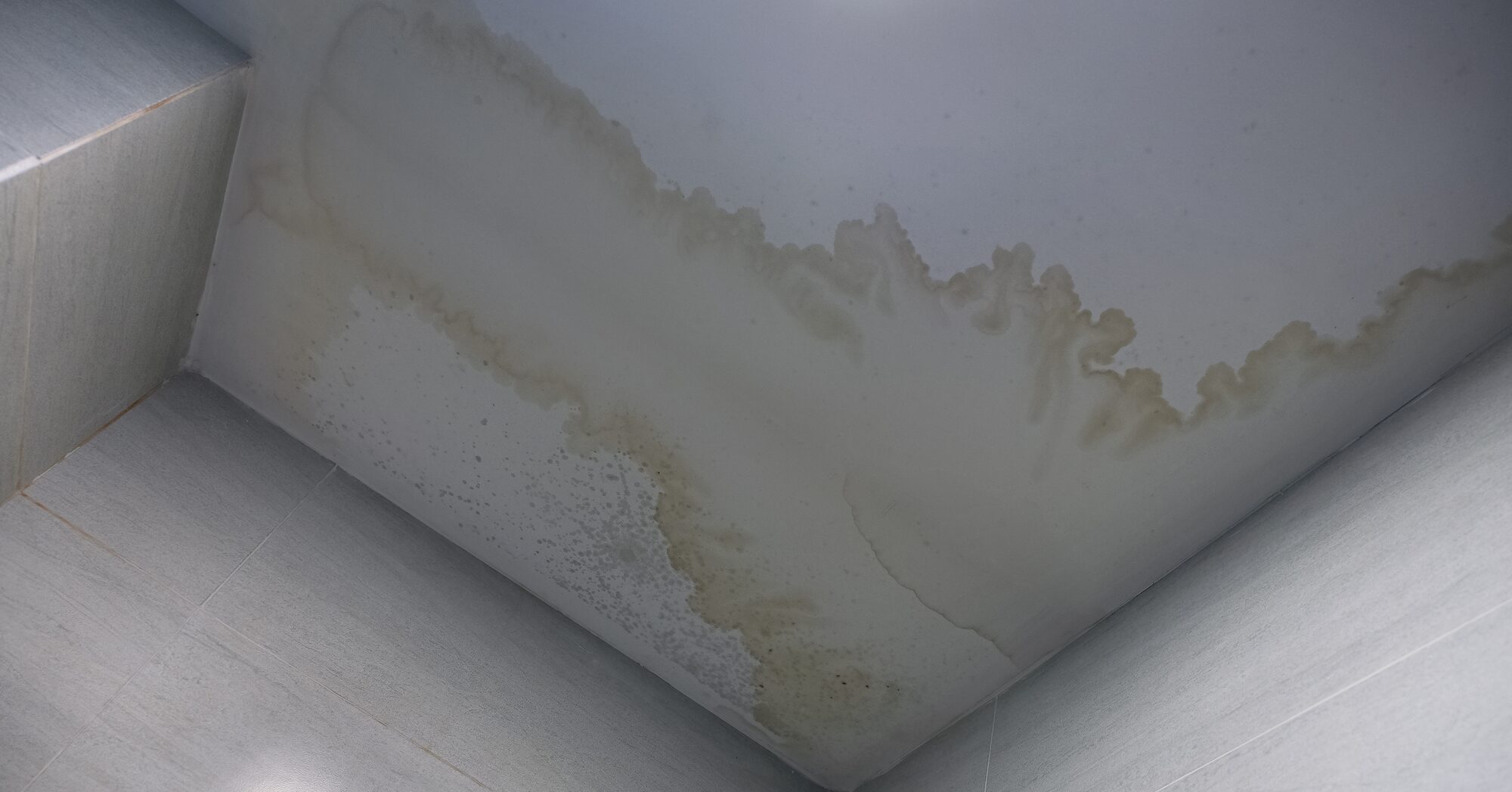
The photograph arrives on a Tuesday from a neighbour, or from the cleaner, or from the tenant downstairs: a brown map spreading across a ceiling in Caleta de Fuste, a blister of paint, a drip into a bucket. The owner is in Düsseldorf or Leeds. Three questions follow in the same minute — where is it coming from, who pays, and who is supposed to call whom — and the order in which they are answered decides whether the next month is a repair or a dispute. This is how the law, the insurers and the communities we administer answer them.
First, where the water comes from
Damp has three origins, and each points to a different payer. Filtration is rain or pool water finding a way through a roof, a terrace, a façade joint or a window frame. A leak is a pipe — supply, drainage, heating — failing somewhere inside the building. Condensation and rising damp are not water arriving from anywhere but the building's own physics: cold walls, poor ventilation, salt-laden ground.
Fuerteventura adds its own signatures. The trade winds drive rain almost horizontally against north- and east-facing façades, so water enters through joints that never see it in a mainland city. Flat roofs and terraces sit under an ultraviolet load that ages an asphalt membrane years ahead of the manufacturer's schedule. Galvanised pipework in the resorts built in the eighties and nineties corrodes from the inside in salt air. And the first serious rain of autumn arrives on roof drains that a summer of calima has quietly blocked — which is why the leak season in the island's communities opens with the first autumn rains, why clearing the roof outlets sits on our autumn checklist, and why a tired membrane is what the building inspection most often finds.
Common or private: the line the law draws
Everything turns on one distinction. The Civil Code lists what belongs to all the owners together — elementos comunes — and the list is long: the roof and the structure, the façades «with the external claddings of terraces, balconies and windows», and «the installations, pipes and channels for drainage and for the supply of water, gas or electricity … all of them up to the entry into the private space» (Código Civil, art. 396). What serves one owner exclusively, inside the limits of their unit, is private (Ley de Propiedad Horizontal, art. 3.a).
In practice that gives three rules of thumb our administrators apply before anyone argues:
- Vertical pipes are common, branches are private. The main stacks and risers — bajantes and montantes — that serve the whole column of flats are common elements up to the point where a branch leaves them to serve one unit. From the stopcock or the branch onwards, the pipe is the owner's.
- The roof is common even when the terrace is yours. A terrace attached to a top-floor flat is for that owner's private use, but where it forms the building's cover, its structure and its waterproofing keep their common nature. The Supreme Court settled the point in its ruling 80/2024 of 23 January 2024: an owner whose private-use terrace had leaked into the flat below through a worn membrane had paid €11,209 for the repair himself, and the community was ordered to reimburse him with interest, because the waterproofing of a roof is common — unless the leak is caused by the user's own misuse or lack of care.
- The wall of a bathroom is private; the wall of the building is not. Damp arriving through a façade joint or a party wall is the community's problem; damp from a shower tray that was never sealed is the owner's.
Who pays what
The Horizontal Property Act sets the duties on both sides. Each owner must keep their own flat and its private installations in good repair «in terms that do not prejudice the community or the other owners, compensating the damage caused by their neglect or that of the persons for whom they must answer» (LPH, art. 9.1.b). The community, for its part, must carry out «the works necessary for the adequate maintenance and fulfilment of the duty of conservation of the building and its common services and installations» — and those works are mandatory and need no prior vote of the junta (art. 10.1.a); the administrator may order the urgent ones and report to the president afterwards (art. 20.c).
So the payer follows the origin. A branch pipe that bursts inside a flat and floods the one below is the upstairs owner's repair, and the damage downstairs is theirs to make good — under article 9.1.b and, in the courts, under the general rule that whoever causes damage by fault repairs it (Código Civil, art. 1902) and the older, stricter rule that the head of a household answers for what falls from the house, which courts have extended to water escaping from a dwelling (art. 1910). A cracked bajante, a failed roof membrane or a façade joint is the community's repair and the community's damage bill, and an owner who lets a building deteriorate for want of repairs answers for the consequences (art. 1907). In a building under ten years old there is a third payer: the builder and the developer answer for defects that compromise habitability — watertightness among them — for three years from the handover, for structural defects for ten, and for finishes for one (Ley de Ordenación de la Edificación, art. 17), and the community can claim against them rather than against its own budget.
Two duties make the repair possible at all. Every owner must allow into their flat the repairs the building's service requires, and must let the community in for the purpose — with the right to be compensated for the damage the works cause (LPH, art. 9.1.c and d). An owner abroad who cannot be reached, or whose flat cannot be opened, is the single most common reason a small leak becomes a large one; it is why we ask every owner abroad for a key-holder on the island and a contact who answers the phone.
Where the insurance steps in
Most communities we administer carry a building policy, and most owners a home policy; the leak is settled between the two, and the origin decides which one leads. As a rule the community's policy covers damage from common elements and the community's liability to third parties, and the owner's policy covers the private installations, the contents and the owner's liability to the neighbour below. Nearly every policy sold in Spain includes a daños por agua cover with the search and location of the leak — opening the wall, finding the pipe, closing the wall — as part of the claim; the broken pipe itself is often excluded, so check the wording before assuming.
The law then sets the clocks. The loss must be notified to the insurer within seven days of learning of it, unless the policy grants longer (Ley de Contrato de Seguro, art. 16). The insurer must pay at least the undisputed minimum within forty days of the notice, and the full amount once its investigations end (art. 18); an insurer that has paid nothing three months after the loss owes interest at the legal rate plus 50 % (art. 20). If insurer and insured disagree on the amount, each names an expert and, failing agreement between them, a third is appointed (art. 38) — the perito whose report decides most leaks in practice.
That report is the document the whole case rests on. The community's insurer sends an expert; the owner's insurer may send another. What they establish — where the water entered, whether the cause is a common element or a private one, whether neglect played a part — fixes who pays and whose policy responds. It is also why the first days matter: photographs before anything is dried or painted, the plumber's invoice that names the pipe, the neighbour's written notice with a date.
The protocol we run
For the communities we administer, a leak follows the same path whoever reports it:
- Register and stop. The incident is logged with photographs and the date; if water is running, the supply is closed at the nearest stopcock and the urgent works ordered under article 20.c.
- Locate. A plumber or the insurer's expert finds the origin. Until the origin is known, nobody is told they will pay.
- Classify. Common or private, by the rules above. Where it is private, the owner is told in writing what article 9.1.b requires of them; where it is common, the repair goes ahead under article 10.1.a without waiting for a junta.
- Claim. The community's insurer is notified inside the seven days; the owner is told to notify theirs. The two experts are put in contact.
- Repair the cause, then the damage. Painting a ceiling over a live leak is the most expensive way to buy three weeks.
- Close the file. The expert's report, the invoices and the insurer's settlement go into the community's records, because a neighbour has one year from learning of the damage to claim for fault against whoever caused it (Código Civil, art. 1968), and a community may need to claim against a builder within the LOE terms.
The owner abroad: what to have in place
Three things reduce a leak to a nuisance when you are two thousand kilometres away. A home policy that names water damage and third-party liability, with the community's administrator as a contact the insurer may call. Keys with someone on the island — a neighbour, an agent, the administrator — so that the duty of access under article 9.1.d can be met the same day. And the habit, before every departure, of closing the stopcock and clearing the terrace drains, which removes the two commonest origins of a private leak at no cost. If the flat is let, the tenant needs the administrator's number as much as the owner's.
Where we come in
Our administrators in Fuerteventura log the incident, coordinate the plumber and both insurers' experts, order the urgent works the law allows and keep the file that settles who pays — in English, German or Spanish, with the owner abroad copied at every step. See our community maintenance and community insurance services, or ask for a quote.
Common questions
Water is coming through my ceiling from the flat above. Who pays?
It depends on where the water starts. If it comes from a private installation of the flat above, such as a branch pipe or an unsealed shower, the upstairs owner repairs it and makes good your damage, usually through their home insurance. If it comes from a common element, such as a main stack, the roof or a façade, the community repairs it and answers for the damage, usually through the building policy. The insurer's expert report establishes the origin.
My terrace leaks into the flat below. Is that my problem or the community's?
If the terrace forms the building's roof, its structure and waterproofing are common elements even though its use is yours, and the community pays for the repair and the damage below — the Supreme Court confirmed this in January 2024. You pay if the leak comes from your own misuse or lack of care, or from surface elements that are yours alone.
How long do I have to tell the insurer?
Seven days from learning of the loss, unless your policy gives you longer. The insurer must then pay at least the undisputed part within forty days and the rest once its expert has reported; after three months without payment it owes interest at the legal rate plus 50 %.
Can the community enter my flat to repair a leak while I am abroad?
Yes. Every owner must allow the repairs the building's service requires and let the community in for them, with the right to compensation for any damage the works cause. Leaving keys with a person on the island, or with the administrator, is how that duty is met without a locksmith.