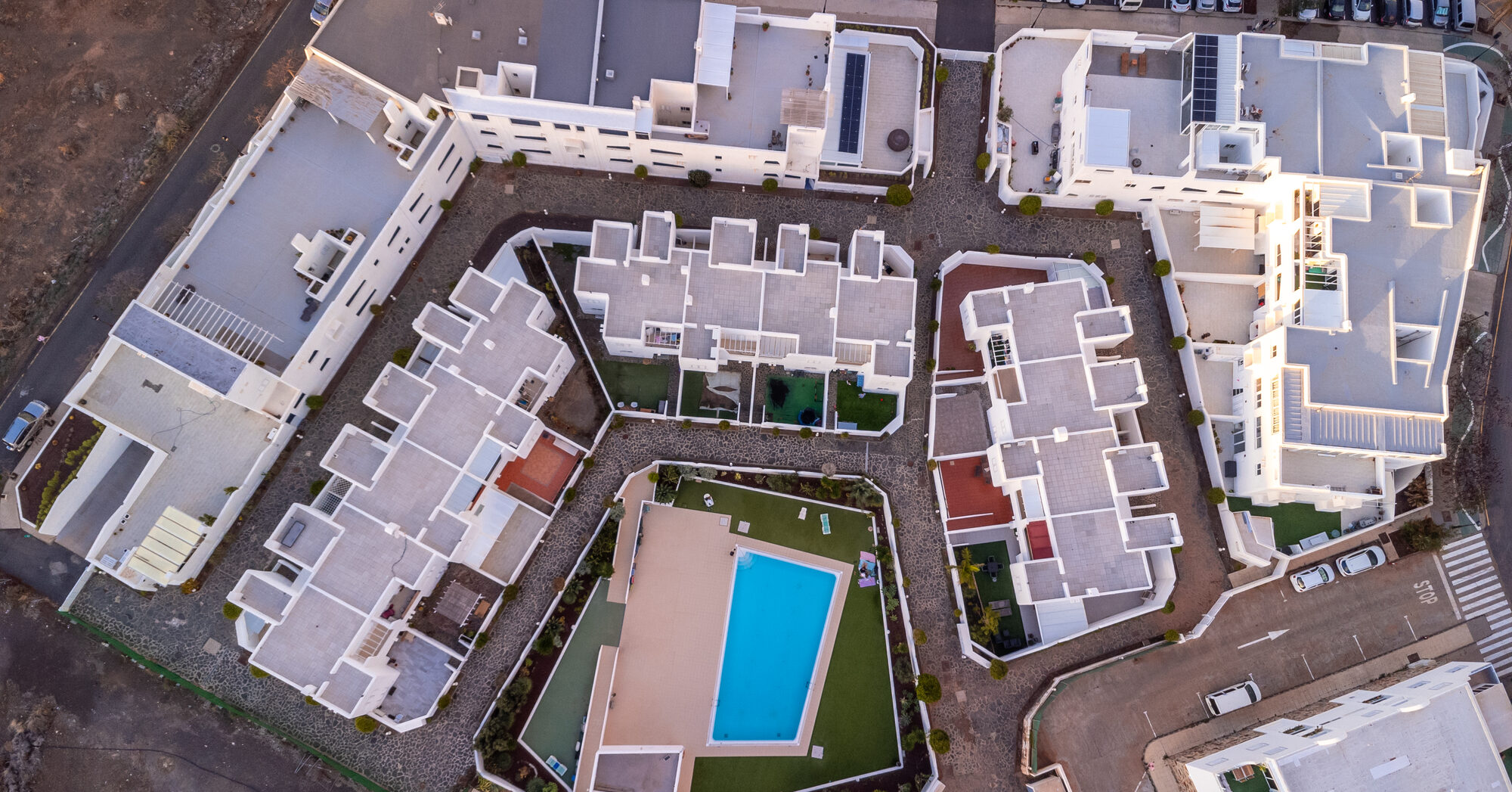
Most of the resorts we administer in Fuerteventura are not one community but several: three or four blocks built in phases, each with its own community of owners, its own president and its own budget, sitting around a pool, gardens, roads, lighting and a gate that belong to all of them together. Owners call the layer that runs those shared parts «the mancomunidad». The Horizontal Property Act does not use the word; it calls the whole thing a complejo inmobiliario privado — a private real-estate complex — and gives it one article, the twenty-fourth, which decides three things every owner in Caleta de Fuste, Corralejo or Costa Calma eventually needs to know: who votes on the pool, who pays for the gardens, and where a resolution is challenged when someone disagrees. This piece reads that article and the ones it leans on. Quotations are in Spanish with the reading in English; the figures in the example are ours, chosen to show the mechanics.
What the law calls a «mancomunidad»
Article 24 opens with two conditions. A complex exists when the estate is made of dos o más edificaciones o parcelas independientes entre sí cuyo destino principal sea la vivienda o locales — two or more buildings or plots independent of each other whose main use is housing or premises (24.1.a) — and when the owners of those buildings, or of the flats they are divided into, share, as something inherent to their title, una copropiedad indivisible sobre otros elementos inmobiliarios, viales, instalaciones o servicios — an indivisible co-ownership of other property elements, roads, installations or services (24.1.b). The pool, the gardens, the internal roads and the perimeter are those elements. Where both conditions are met, the special property regime of article 396 of the Civil Code applies to the shared layer, and with it the Act, which lists private complexes among the communities it governs (article 2.c).
The Act also names the opposite case, the community inside a community. A subcomunidad — sub-community — exists when, under the constitutive title, varios propietarios disponen, en régimen de comunidad, para su uso y disfrute exclusivo, de determinados elementos o servicios comunes dotados de unidad e independencia funcional o económica — several owners hold, as a community, for their exclusive use and enjoyment, certain common elements or services with functional or economic unity and independence (article 2.d). A pool that only two of the four blocks may use is a sub-community of those two blocks, and its cost stays with them.
The three legal shapes a resort can have
Article 24.2 gives a complex two ways to organise itself, and 24.4 covers the resorts that chose neither. Which of the three your resort has is the first thing we check in its title deeds, because the answer changes everything below.
The first shape is one single community for the whole complex: the complex may Constituirse en una sola comunidad de propietarios — constitute itself as a single community of owners (24.2.a) — through the procedures of article 5, and then the Act applies to it in full. Every owner votes at one meeting, on one budget, by one quota over the whole estate. It is the simplest shape and the rarest in resorts built in phases.
The second is the agrupación de comunidades de propietarios — the grouping of communities (24.2.b) — which is what most owners mean by mancomunidad. It needs a constitutive title granted por el propietario único del complejo o por los presidentes de todas las comunidades llamadas a integrar aquélla, previamente autorizadas por acuerdo mayoritario de sus respectivas Juntas de propietarios — by the sole owner of the complex or by the presidents of all the communities called to form it, previously authorised by a majority resolution of their respective meetings. That title must describe the complex as a whole and the shared elements, roads, installations and services, and fijará la cuota de participación de cada una de las comunidades integradas — fix the participation quota of each member community — which responderán conjuntamente de su obligación de contribuir al sostenimiento de los gastos generales de la comunidad agrupada — answer jointly for their obligation to contribute to the general expenses of the grouped community. The title and the statutes are registrable at the Land Registry, and a registered title is the document that binds the buyer who arrives ten years later. Constituting or modifying a complex also needs the town hall's authorisation, or its notarial testimony, before the Registry will take it, unless the private elements are the ones the building licence already allowed (article 26.6 of the consolidated land law).
The third shape is no shape at all. Article 24.4 says that complexes which adopt neither form are governed supletoriamente respecto de los pactos que establezcan entre sí los copropietarios — supplementarily to the agreements the co-owners make among themselves — by the Act, with the same specialities as a grouping. Many older Fuerteventura resorts live here: a shared account, a habit of meeting once a year, a cost split that «has always been like this», and no registered title of the complex. It works until the first dispute, because the agreements come first and the Act only fills their gaps, and nobody can produce the agreements.
Who sits at the resort's table
Article 24.3 gives the grouped community la misma situación jurídica que las comunidades de propietarios — the same legal position as a community of owners — with three specialities. Its meeting estará compuesta, salvo acuerdo en contrario, por los presidentes de las comunidades integradas en la agrupación, los cuales ostentarán la representación del conjunto de los propietarios de cada comunidad — is made up, unless otherwise agreed, of the presidents of the member communities, who represent all the owners of each community (24.3.a). An individual owner does not vote at the resort's meeting; they vote at their block's meeting, which instructs the president, and the president carries that vote. Being president of your block from abroad therefore also means being your block's voice on the pool and the gardens.
Second, any resolution for which the Act demands a qualified majority exigirá, en todo caso, la previa obtención de la mayoría de que se trate en cada una de las Juntas de propietarios de las comunidades que integran la agrupación — requires, in every case, that the majority in question be obtained first in each of the member communities' meetings (24.3.b). A new installation, a change of the title, the removal of a barrier: the presidents cannot decide it among themselves; each block must have voted it first with the majority its own meeting needs. Third, the reserve fund of article 9 does not apply to the grouped community Salvo acuerdo en contrario de la Junta — unless the meeting agrees otherwise (24.3.c). In the resorts we administer we recommend agreeing it, because a pool pump and a pump room are exactly the kind of expense the 10 % fund of article 9.1.f exists for.
The last sentence of 24.3 draws the border. The competence of the grouped community's organs únicamente se extiende a los elementos inmobiliarios, viales, instalaciones y servicios comunes — extends only to the shared property elements, roads, installations and services — and its resolutions no podrá menoscabar en ningún caso las facultades que corresponden a los órganos de gobierno de las comunidades de propietarios integradas — may in no case diminish the powers of the member communities' governing organs. The mancomunidad decides the pool and the gate; it does not decide your block's roof, its lift or the colour of its façade.
Who pays what: the quota and the keys
The general rule of every community is article 9.1.e: each owner contributes con arreglo a la cuota de participación fijada en el título o a lo especialmente establecido — according to the participation quota fixed in the title or to what is specially established — to the general expenses that cannot be individualised. In a grouping the same rule works in two steps. The title of the complex fixes the quota of each member community (24.2.b); each community pays that share of the resort's budget out of its own budget; and inside the block each owner pays their own quota of their community's share. The quota itself is the one article 5 describes, set in the title on the basis of la superficie útil de cada piso o local en relación con el total del inmueble, su emplazamiento interior o exterior, su situación y el uso que se presuma racionalmente que va a efectuarse de los servicios o elementos comunes — the usable surface of each flat or premises in relation to the whole, its interior or exterior location, its situation and the use it is reasonably presumed to make of the common services and elements — and article 3 makes it the módulo para determinar la participación en las cargas y beneficios — the module for sharing the burdens and the benefits.
The words o a lo especialmente establecido are where the keys live. The title or the statutes of the complex may split a given cost differently from the quota: gardens by quota but the pool by number of dwellings, the commercial premises on the ground floor exempt from the pool and the lifts, a block with its own private pool exempt from the shared one, security shared by the blocks the gate actually serves. Article 5 allows the title to carry rules on gastos, administración y gobierno, seguros, conservación y reparaciones — expenses, administration and government, insurance, conservation and repairs — forming a private statute that binds third parties only once registered. What the title and the statutes do not say, the quota decides.
| Shared element |
Default key |
What can change it |
| Pool, its plant room and the lifeguard season |
Each community's quota in the title, then each owner's quota in their block |
A statute key by dwellings; an exemption for premises or for a block with its own pool; a sub-community under article 2.d |
| Gardens, roads, lighting, perimeter |
The quota |
A statute key; a block outside the fence excluded by the title |
| Gate, porter or security patrol |
The quota |
A key by the blocks the service actually covers |
| The resort's insurance and administration |
The quota |
Rarely changed; the policy must name the complex, not one block |
| A new installation the resort votes |
The quota, once the three-fifths majority of article 17.4 is reached block by block |
Article 17.4's opt-out: a dissenter is not bound by a non-necessary installation costing more than three months of ordinary fees |
Take a resort in Caleta de Fuste with four blocks of 48, 48, 36 and 24 dwellings and a shared budget of €60,000 a year: pool €14,000, gardens €16,000, common-area electricity €7,000, gate and porter €12,000, the complex's insurance €4,000, administration and fund €7,000. The title gives the blocks 30 %, 30 %, 25 % and 15 %, so block A pays €18,000 a year and an owner with one forty-eighth of block A pays €375. Had the title said «by dwellings», block A's 48 of 156 would be 30.77 % and the same owner would pay €384.61. And if block D were a tourist block with its own pool that the title exempts from the shared one, the €14,000 of the pool would be split among the other three by their quotas re-scaled: block A's share rises from €4,200 to €4,941, about €15 more a year for that owner. None of these figures is a rule; each is the arithmetic of one line in the title, which is why the title is read before the budget is drafted.
Changing a key is not a budget decision. A different split of the pool or an exemption for a block modifies the title or the statutes, and article 17.6 requires for that la unanimidad del total de los propietarios que, a su vez, representen el total de las cuotas de participación — the unanimity of all the owners representing all the quotas — reached, in a grouping, block by block under 24.3.b. Article 17.8 helps with the absent: owners duly summoned who do not object to the secretary en el plazo de 30 días naturales — within thirty calendar days — of being told the resolution are counted as votes in favour, except where the cost cannot be charged to those who did not vote for it.
The tourist block at the table
In the three resort areas of the island one of the member communities is often not a residential block but a tourist establishment run by an operator. The Canary tourism act requires that operation to follow the principio de unidad de explotación — the principle of single operation — which it defines as el sometimiento a una única empresa de la actividad de explotación turística alojativa en cada uno de los establecimientos — the submission of the tourist accommodation activity in each establishment to a single company (article 38 of the Ley 7/1995). For the mancomunidad the consequence is practical rather than legal: that block sits at the table through its president like any other, pays the quota the title gives it, and answers for it; what happens inside it, from the use of its own pool to the hours of its bar, is the operator's business under its licence, not the resort's. Where a title was written when the whole complex was a hotel and the residential blocks came later, the quotas and the keys are the first thing to re-read.
Rules of use, debtors and the pool gate
For the day-to-day of the shared parts the Act offers article 6: Para regular los detalles de la convivencia y la adecuada utilización de los servicios y cosas comunes — to regulate the details of coexistence and the proper use of common services and things — the owners may set internal rules that obligarán también a todo titular — bind every owner as well — within the limits of the law and the statutes. The presidents' meeting can adopt them for the pool, the gardens and the gate by the ordinary majority of article 17.7, and they reach every owner of every block, and their tenants and guests. The Canary rules on pool safety, the registry and the lifeguard are a separate layer, read in our piece on community pools in the Canaries; the resort's internal rules sit under them.
Arrears at the resort level follow the same law as arrears in a block. Article 21.1 lets the meeting agree medidas disuasorias frente a la morosidad — dissuasive measures against arrears — tales como el establecimiento de intereses superiores al interés legal o la privación temporal del uso de servicios o instalaciones — such as interest above the legal rate or the temporary deprivation of the use of services or installations — provided they are not abusive or disproportionate, do not affect the habitability of the dwellings and are not retroactive. A pool card that stops working while the fees are unpaid is lawful when the statutes or the meeting have adopted it under those limits; cutting the water to a flat is not. And article 15.2 removes the vote, not the voice, from an owner who is not up to date when the meeting opens, with their quota left out of the majorities. The claim itself, the debt certificate and the court route are in our piece on unpaid fees; in a grouping the creditor is the member community for its owners' fees and the grouped community for the community's share.
Money, insurance and liability at the resort level
A grouped community is a community for all purposes, so it keeps its own budget, its own bank account in its own name and tax number, its own accounts approved once a year at the presidents' meeting, and its own insurance. The policy must be the complex's, naming the pool, the plant room, the gardens' installations and the perimeter, because a block's building policy stops at the block; our piece on the community policy explains what a building policy covers and what it does not. Liability runs the way article 22.1 describes: the community answers for its debts con todos los fondos y créditos a su favor — with all its funds and credits — and only afterwards, previo requerimiento de pago al propietario respectivo — after a demand for payment to the respective owner — may a creditor go against each owner who was a party to the proceedings for their quota of the unpaid amount. In a grouping that means the resort answers first with its funds, then each member community for its quota, then, inside the community, each owner for theirs.
Disputes and the challenge window
A resolution of the resort's meeting is challenged like any other, under article 18. The grounds are three: resolutions contrarios a la ley o a los estatutos de la comunidad de propietarios — contrary to the law or the statutes (18.1.a); resolutions gravemente lesivos para los intereses de la propia comunidad en beneficio de uno o varios propietarios — seriously harmful to the community's interests for the benefit of one or several owners (18.1.b); and resolutions that supongan un grave perjuicio para algún propietario que no tenga obligación jurídica de soportarlo o se hayan adoptado con abuso de derecho — cause serious harm to an owner who has no legal obligation to bear it, or were adopted in abuse of right (18.1.c). Standing belongs to the owners who hubiesen salvado su voto en la Junta, los ausentes por cualquier causa y los que indebidamente hubiesen sido privados de su derecho de voto — recorded their dissenting vote, were absent for any reason, or were wrongly deprived of their vote (18.2) — and only if they are up to date with the community or have deposited the debt with the court.
The window is short: La acción caducará a los tres meses de adoptarse el acuerdo — the action lapses three months after the resolution — salvo que se trate de actos contrarios a la ley o a los estatutos, en cuyo caso la acción caducará al año — except for acts contrary to the law or the statutes, where it lapses after a year (18.3). For absent owners the clock starts when the resolution is notified to them under article 9, which is why the minutes must go out. And challenging does not stop the works: La impugnación de los acuerdos de la Junta no suspenderá su ejecución — challenging the resolutions does not suspend their execution — unless the judge orders it as a precaution (18.4).
One question article 24 does not answer is who may challenge the grouped meeting's resolution when its members are presidents, not owners. The courts have answered it case by case, and the practical route is the safe one: an owner who objects raises it at their own block's meeting, has the dissent recorded there and instructs the president, and the block's lawyer takes it from there within the three months. What an owner should never do is wait for the next annual meeting; by then the window has closed.
What we do for resorts
For the complexes we administer in Fuerteventura we run the two layers as the law draws them: one budget and one set of accounts for the grouped community and one for each block, the quotas and keys applied exactly as the registered title says, the presidents' meeting convened with the notice, the agenda and the arrears list article 16 requires, and the block meetings held first when a qualified majority is needed. Where a resort has no title of grouping we say so at the first meeting and put the cost of formalising it, at the notary and the Registry, next to the cost of the next dispute. Owners abroad receive the resort's minutes and their block's in the languages the contract promises, from three service points on the island. Our community administration service describes the standard; ask for a quote with the number of blocks and the shared elements, and we will read your title before we answer.
Common questions
I never use the pool. Can I stop paying my share of it?
No. Article 9.1.e ties the contribution to the quota or to what the title specially establishes, not to use. Only an exemption written into the title or the statutes, or a sub-community under article 2.d that leaves your block outside the pool, changes that, and adding one now needs the unanimity of article 17.6, block by block.
Who convenes the resort's meeting, and may an ordinary owner attend?
The president of the grouped community convenes it under article 16, with the same notice, agenda and arrears list as any meeting. The members are the presidents of the blocks unless the title says otherwise (24.3.a); other owners may attend if the meeting allows it, but the vote is the president's, carrying the instruction of the block's own meeting.
Can the resort's meeting decide works on my building?
Not on your building's own elements. Article 24.3 limits the grouped community's competence to the shared elements, roads, installations and services and forbids its resolutions from diminishing the powers of the member communities. The roof, the lift and the façade of your block belong to your block's meeting; the pool, the gardens and the gate to the resort's.
Our resort has no title of grouping. What applies?
Article 24.4: the agreements the communities have made among themselves first, and the Act with the specialities of a grouping where those agreements are silent. Formalising the grouping needs the title of article 24.2.b, granted by the presidents with a majority in each block, plus the town hall's authorisation or the licence exception of article 26.6 of the land law, and its registration. It costs a notary and the Registry; the alternative costs the first serious dispute.