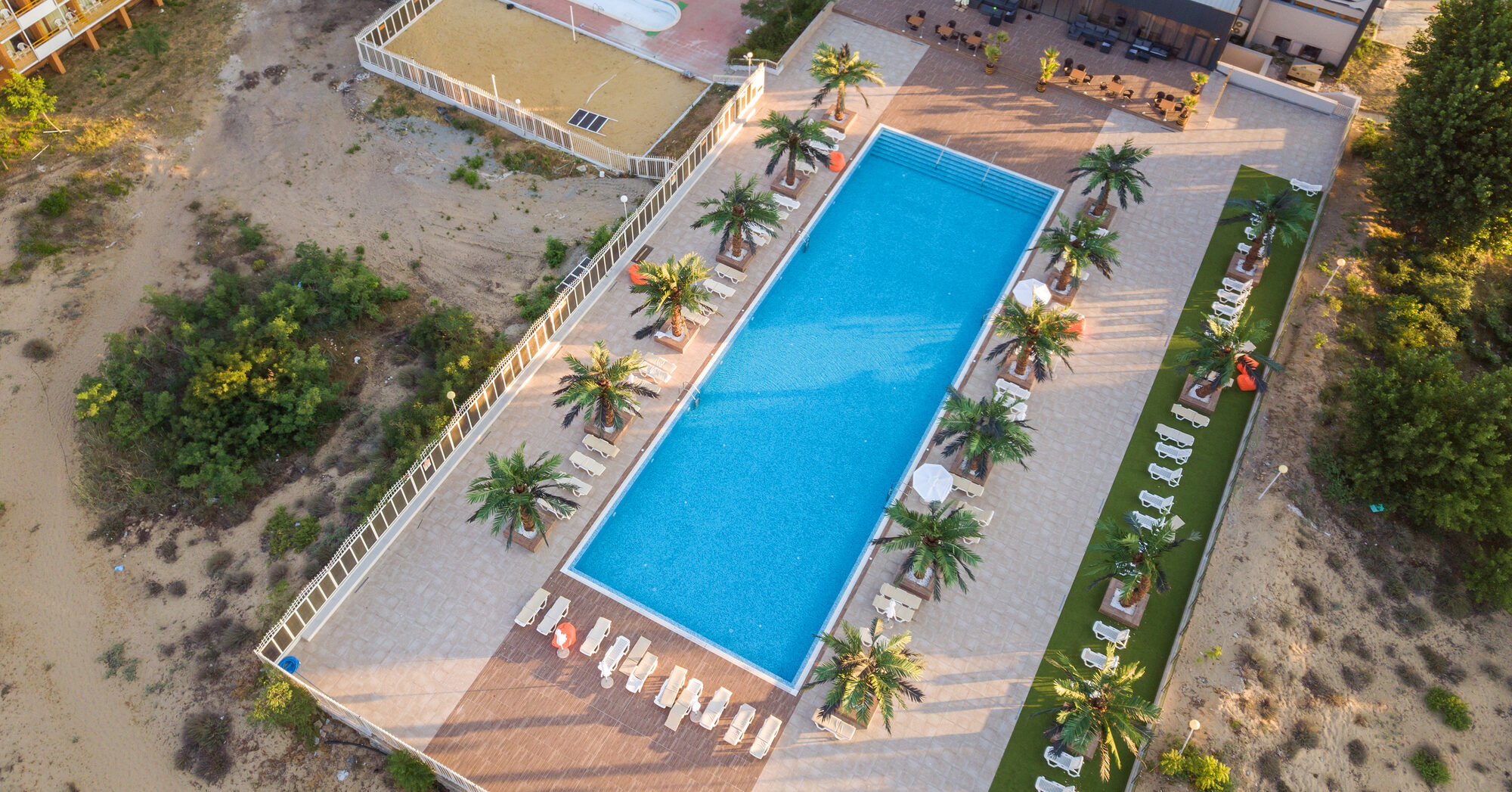
Most of the communities we administer in Fuerteventura have a pool, and for the owner who lives in Hamburg or Leeds it is the part of the building they think about most and know least: who checks the water, whether a lifeguard is required, what the health inspector looks for, and what happens if a child is hurt on the deck. The answers are not in the Ley de Propiedad Horizontal. They are in a Canarian health decree from 2005, a state decree from 2013 and, for the showers and the spa, a legionella decree from 2022 — and they land on the community as the pool's titular, not on the maintenance company it hires.
This piece sets out what those rules say for a community pool in the Canary Islands, quoted in Spanish with the reading in English, with the year's calendar at the end.
Three rulebooks and one responsible party
The Canary Islands regulate pools through the Decreto 212/2005, de 15 de noviembre, which approved the Reglamento sanitario de piscinas de uso colectivo — published in the Boletín Oficial de Canarias on 1 December 2005, in force since June 2006 — as amended by the Decreto 119/2010, de 2 de septiembre, in force since 16 September 2010. Its scope is wide on purpose: a collective-use pool is any pool that is not exclusively single-family, «independientemente de que se encuentren ubicadas en comunidades de propietarios, establecimientos turísticos, sociedades, clubes…» — whether located in communities of owners, tourist establishments, associations or clubs (art. 2.2). Only single-family pools, thermal baths, natural seawater pools and hydromassage pools fall outside it (art. 3.1).
Over it sits the state Real Decreto 742/2013, de 27 de septiembre, in force since 11 December 2013, which fixes the basic sanitary criteria for water and air in every pool in Spain. It classifies pools by use — public pools of type 1 and type 2, private pools of type 3A, expressly «piscinas de comunidades de propietarios», and type 3B, single-family pools (art. 2) — and for type 3A it makes a minimum set of its articles compulsory: design and safety elements, water treatment, the chemicals used, the water-quality criteria, the notification of serious incidents and part of the information for users (arts. 5, 6, 7, 10, 13 and 14.d, e and f, by art. 3.2). The Canary Islands health service applies both texts to a community pool, and says so on its own pools page.
The third text is the Real Decreto 487/2022, de 21 de junio, on the prevention of legionellosis, in force since 2 January 2023 and amended in July 2024; we come to it below.
Who is responsible is the point owners most often get wrong. The Canary decree names the pool's titular as the person who owns it (art. 2.15); the state decree spells out that the titular may be «una comunidad de propietarios» (art. 2.8). And the decree leaves no room for passing the responsibility to the company that cleans the filters:
«El titular de la piscina es el responsable del funcionamiento, mantenimiento y vigilancia de sus condiciones sanitarias y de seguridad, así como del cumplimiento de las previsiones contenidas en este Reglamento» — the titular is responsible for the operation, maintenance and surveillance of the pool's sanitary and safety conditions, and for compliance with the regulation. «La existencia de servicios de mantenimiento externo no exime al titular de la instalación de su responsabilidad» — an external maintenance service does not release the titular from its responsibility (art. 32).
In a community of owners that responsibility is discharged by the president and the administrator; the maintenance company is a contractor whose work the community must be able to show.
The lifeguard rule and the forty-unit exception
The rule comes first and the exception second, and both matter in Fuerteventura because so many communities are, or sit inside, tourist complexes.
«Las piscinas de uso colectivo contarán al menos con la presencia de un socorrista durante el horario de funcionamiento» — collective-use pools shall have at least one lifeguard present during operating hours (art. 34.3).
The exception, rewritten in 2010, is the one that governs most residential communities:
«Están exentas de la obligación de tener socorrista las piscinas ubicadas en edificaciones y construcciones de uso residencial no turístico, así como en establecimientos que ofrezcan servicios de alojamientos turísticos y cuya capacidad no exceda de 40 unidades alojativas, siempre que los vasos o la piscina dispongan de barreras de protección que impidan el acceso a los niños menores de seis años que no vayan acompañados por un adulto» (art. 34.5).
Read slowly, it covers two situations and excludes a third:
- A residential building or complex not used as tourist accommodation is exempt from the lifeguard, provided the vaso or the pool enclosure has protective barriers that keep children under six from reaching the water unaccompanied.
- A tourist establishment with no more than forty accommodation units is exempt on the same condition.
- A tourist establishment with more than forty units must have a lifeguard for the whole of the pool's opening hours, and the decree places that duty on the tourist operator — the explotador turístico — who answers for its breach (arts. 34.7 and 44); the regional tourism department reports those establishments to the pool registry (art. 38.4). Our piece on holiday lets and the community explains how a complex comes to be classed as tourist accommodation.
The barrier is not a decorative fence. The decree sends it to the Technical Building Code's safety document, and Section SUA 6 of that code requires, for pools where children's access to the bathing area is not controlled, barriers that prevent access to the vaso except through the points provided for it, each with an openable element with a closing and locking system; the barriers must be at least 1.20 m high and withstand a horizontal force of 0.5 kN/m at the top edge. The health service's own guidance adds that the enclosure may hug the deck or take in the solarium and lawns, but the area inside it may not be in ordinary use outside the pool's hours.
Two further duties follow from the exemption. The pool must display, «como mínimo en español e inglés», a sign in a visible place stating that it is a pool exempt from having a lifeguard (art. 36.2), and the exemption must be recorded in the pool registry and in the log book (art. 34.6). Where a lifeguard is on duty, the decree wants a first-aid kit with the contents of its annex 3 in their charge (art. 35.1), and their qualification is the thirty-hour course the decree describes or one of the official qualifications the health service listed in June 2025 as exempting from it.
The choice between a barrier and a lifeguard is the meeting's. Our reading — it is a reading, not a line of the law — is that a barrier installed to meet the exemption's condition is a safety work in the sense of article 10.1.a of the Ley de Propiedad Horizontal, obligatory and paid by quota, while hiring a lifeguard where the law does not demand one is a new common service of general interest under article 17.3, which needs three fifths of the owners representing three fifths of the quotas. A lifeguard is a salary for every opening day; a barrier is one work and a gate to keep in order, which is why nearly every residential community chooses the barrier — and then forgets the sign.
The registry: is your pool in it?
Every collective pool in the Canaries must be entered in the Registro de Piscinas de Uso Colectivo de Canarias, kept by the regional public-health directorate (art. 38.1). The entry is made de oficio once the titular has communicated, before the pool starts operating, the start of its activity on the decree's form, with proof of payment of the registration fee (art. 38.2). The procedure is electronic on the Canary government's sede, number 8504, open all year and resolved within three months; the health service's 2024 guide lists the documents — an establishment sheet, one sheet per vaso, the titular's tax number, proof of ownership or operation, the administrator's authority — and quotes the fee at 2.46 euros. A pool that was already running before 16 September 2010 is entered on the strength of a favourable health report, a municipal licence that included the pool, or the log book issued under the 1989 order the decree replaced.
Why it matters is written in the decree twice: the persons who appear in the registry as titulares are the ones responsible for infringements (art. 44), and a pool operating without its authorisation or registry entry may be closed by the health service until the defect is cured — a police measure rather than a sanction, so no infringement has to be proved first (art. 45). Since December 2023 the registry is also public: the regional mapping service publishes the registered pools as a layer of IDECanarias, updated yearly, so an owner can check from abroad whether the community's pool appears at all.
The entry is not a one-off. The titular must keep the registry data current and communicate any change (art. 38.5): a new administrator as the contact, a change of owner or of tourist operator, a change in the chemicals used, all go through the update procedure (sede 8936). A reform that touches the structure of a vaso needs a mandatory and binding health report before the works, issued within thirty days on a technical project (art. 37, sede 8301), and the registry is updated after them with the favourable report attached; a new pool follows the same path, and the report is a precondition of the municipal permits.
The log book and the two readings a day
For each vaso the titular keeps a Libro de Registro del Control Sanitario, numbered and validated by the public-health directorate and issued once the pool is registered (art. 41.1). Since the registry went online the book is downloaded from the registry's application by the person the community has named as its external user (sede 8934), one book per vaso, renewable after a year. The book stays at the pool: it is available to the health inspector and stamped at every inspection, the inspector notes in it any sanitary incident they think relevant, and — a line worth knowing — «los usuarios de la instalación podrán consultar este Libro dentro del horario de funcionamiento de la piscina»: users may consult it during opening hours (art. 41.2). Its absence, or false entries in it, is the titular's responsibility (art. 41.3).
What goes in it is fixed by the decree's annex 7: for every day the pool is open, at two sampling times — «apertura y máxima afluencia», opening and peak attendance — the presence of foam, grease or foreign matter, the pH, the transparency and the residual disinfectant, plus water and air temperature and relative humidity in a covered heated pool. The values to hold come from the decree's annex 1, with the state decree's annex I alongside it:
- pH between 7 and 8, with 7.2 to 7.4 recommended (Canary annex); the state annex asks for 7.2 to 8.0 and closes the vaso below 6 or above 9.
- Free chlorine between 0.8 and 3 mg/L (Canary annex); the state annex sets 0.5 to 2.0 mg/L and closes the vaso when chlorine is absent or above 5 mg/L. A community pool kept between 0.8 and 2 mg/L satisfies both tables at once.
- Combined chlorine no more than 0.6 mg/L in both texts.
- Transparency: the bottom drain must be clearly visible.
- The laboratory block, at least quarterly under the Canary annex: turbidity no more than 2 UNF, the Langelier saturation index between −0.5 and +0.5, and absence of Escherichia coli, enterococci, Staphylococcus aureus and Pseudomonas aeruginosa; where stabilised chlorine is used, isocyanuric acid no more than 75 mg/L.
The daily readings are taken with the pool's own kit, which the decree requires on site (arts. 27.3 and 29). The book also carries the pool's self-control programme (art. 40): a treatment plan describing the circuit from the supply point to the vaso and every product used, with its registration number and safety sheet, and a revision, maintenance and cleaning plan with the tasks and their frequency, each operation recorded with its date (art. 42). The treatment runs through the plant — the state decree allows dosing in the vaso itself only with the pool closed and a safety interval before it reopens (art. 6.3) — with filtration and disinfection working the whole time the pool is open and the full volume recirculated in no more than four hours (arts. 25 and 26).
On staff, the Canary decree asks for people able to run the equipment, handle the chemicals and take the readings, in-house or contracted (art. 33). The state decree added in 2023 a professional qualification for the staff who run a pool's treatment programme; the Canary health service applies it to type 1 and type 2 pools, so a community pool is not caught by it, but a maintenance contractor should still be able to show the training of the people it sends.
Opening the season and closing it
On the island a community pool is rarely closed for long — many run all year, others shut for the winter months or cut their hours — but the rules around a stop are the same however long it lasts. No maintenance, cleaning or emptying, even partial, may be done during opening hours (art. 30.1); the moment a vaso starts to be emptied its use is forbidden and physical barriers keep users out for as long as it stays empty (art. 30.2); emptying is done when the water quality requires it and whenever the health authority orders it (art. 24.3).
Before the water takes swimmers again, the state decree's control inicial is the sensible reference: a full annex-I analysis in the fortnight before opening, mandatory in any case after a vaso has been shut for more than two weeks (art. 11.2.a). That article is not in the minimum list for community pools, but the Canary log needs values in range on the first open day, and a laboratory result before the reopening is the only way to be sure of them.
The surroundings have their own checklist. Showers — one per thirty users of the pool's capacity, never fewer than two, timed, on drinking water — must be cleaned, descaled and disinfected at least once a year against legionella (art. 6), as must the taps and pipes of the toilets (art. 9.2); a community pool needs no changing rooms, only a toilet with basin and WC near the vaso (art. 9.3). Every vaso except a paddling pool has a lifebuoy with a rope long enough to reach any point of it (art. 7). The capacity is one user per four square metres of water (art. 2.16), and the pool must display its rules and warnings: children under six accompanied in the adult vasos, shower before bathing, no glass, no pets except guide dogs, the depths, the capacity and the opening hours, the nearest emergency services and 112, the existence of complaint forms (art. 36.1); the state decree adds information on the chemicals used, on whether there is a lifeguard, and on the users' rights and duties (art. 14.d, e and f). Pool hours and the glass rule belong in the community's house rules, which we covered in our piece on house rules that hold up.
The health service inspects periodically and may take samples (art. 43.1). Deficiencies that pose no danger earn a deadline proportionate to their importance; deficiencies that could endanger users, or a deadline that passes uncured, bring the measures the authority sees fit, including suspension of the activity (art. 43.2).
Legionella: the showers, the jets and the spa
The legionella decree of 2022 applies to installations that use water and produce, or may produce, aerosols capable of carrying the bacterium (art. 3.1), and its annex I names among them heated water systems at 24 °C or more with aerosolisation — spas, jacuzzis, hydromassage vasos, pool vasos with jets, waterfalls, mushrooms and play features. It also excludes «las instalaciones ubicadas en edificios dedicados al uso exclusivo de vivienda, siempre y cuando no afecten al ambiente exterior de estos edificios» — installations in buildings used exclusively as housing, so long as they do not affect the outside environment — while allowing the health authority to demand controls wherever it suspects a risk (art. 3.2).
For a community that means three things. A purely residential block is, in the ordinary case, outside the decree's control plans, but a complex run as tourist accommodation is not a building «dedicado al uso exclusivo de vivienda». The Canary pool decree's own yearly cleaning, descaling and disinfection of the showers and taps applies to every community pool regardless (arts. 6.4 and 9.2). And the state pool decree's water table requires Legionella below 100 colony-forming units per litre only in heated vasos with aerosolisation, so a plain unheated pool is never tested for it and a heated spa with jets always is. A community with a heated vaso and jets, or a waterfall feature, should ask its maintenance contractor for a written legionella control plan rather than assume the pool contract includes one: the Canary decree keeps hydromassage pools outside its own scope (art. 3.1.d) and its preamble points to the legionella rules for the elements that generate aerosols.
When something goes wrong: who answers, who pays
Serious incidents are reported. A drowning, a spinal or head injury, a serious burn, an electrocution, a chemical poisoning or an entrapment in a drain — in the vaso, the plant room, the chemical store or the toilets — must be communicated to the regional public-health directorate within ten days, and the health service says this of every pool, public or private (sede 8917; state art. 13 and annex V).
The administrative liability is the titular's. Infringements are sanctioned under the state health laws and the Canary health law (art. 44 of the decree; art. 16 of the state decree), the persons answerable being those in the registry as titulares — and, for the lifeguard duty in a tourist complex over forty units, the tourist operator. The closure of an unregistered pool needs no infringement at all (art. 45).
The civil liability is the community's. «El que por acción u omisión causa daño a otro, interviniendo culpa o negligencia, está obligado a reparar el daño causado» (Código Civil, art. 1902); the community answers for the people it employs, a lifeguard included (art. 1903), and the owner of a building answers for damage from the want of necessary repairs (art. 1907). A community of owners answers for its debts with its funds and, subsidiarily, each owner with their share (Ley de Propiedad Horizontal, art. 22.1) — which is why the liability cover in the community's policy must be sized for the pool, with the per-victim limit read, as we set out in our piece on the community's insurance policy. An unregistered pool, a missing barrier or an empty log book is what an insurer's expert looks for first.
The cost is a general expense. Maintenance, chemicals, analyses, the lifeguard where required and the barrier are common costs shared by quota (LPH art. 9.1.e), and the owner who never swims still pays: «sin que la no utilización de un servicio exima del cumplimiento de las obligaciones correspondientes» (art. 9.2). Whether the pool opens in winter is the meeting's to decide; whether it is kept lawful is not.
The pool year for a community in Fuerteventura
- Every open day, twice: foam, pH, transparency, disinfectant in the log book, at opening and at peak; pH between 7.2 and 8 (7.2 to 7.4 recommended), free chlorine 0.8 to 2 mg/L, combined chlorine under 0.6.
- Every quarter: the laboratory block — turbidity, Langelier, the four bacteria, isocyanuric acid where stabilised chlorine is used — filed in the book.
- Every year: showers, taps and pipes cleaned, descaled and disinfected against legionella, with the date in the book; the log book renewed from the registry application; the signage checked, the exempt-from-lifeguard sign in Spanish and English among it; the barrier gates' closers and locks tested; the liability limit in the policy reviewed against the pool.
- Before any reopening after more than two weeks closed: a full laboratory analysis; a stopped vaso fenced off while empty.
- At every change: a new administrator, president or owner as contact, a new operator, a change of chemicals — the registry updated; any works on a vaso's structure — the health report first, the update after.
- Within ten days of a serious incident: the communication to the public-health directorate, and to the insurer within the seven days the insurance contract act allows.
- On the autumn walk: the pool file — registry entry, log book, contractor's records, analyses, lifeguard or barrier evidence — as one item of the autumn checklist, next to the lift's inspection certificate we described in our piece on lifts after RD 355/2024.
Where we come in
For the communities we administer the pool has a file, and the file is online. The registry entry, the scanned log book, the laboratory reports, the maintenance contractor's visits with their photographs and the yearly legionella treatment of the showers sit in the community's documents on our owner platform, so that an owner in Munich can see in February that the January readings were taken and the quarterly analysis came back clean. We keep the registry data current — the contact, the operator, the chemicals — and we file the health report before a vaso is touched. An incident at the pool is reported with photographs, the insurer is notified within its deadline, and the communication to the health directorate goes out within its ten days. Where a community still runs without a barrier, or with a barrier and no sign, we bring the decision to the meeting with quotes and the decree's article beside them. The community maintenance page describes the service, our administration for non-resident owners page what an owner abroad sees, and a quote is a form away.
Common questions
Does our community pool need a lifeguard?
Not if the building is residential and not used as tourist accommodation, or is a tourist establishment with no more than forty accommodation units — provided the vaso or the pool enclosure has a protective barrier that keeps children under six from reaching the water unaccompanied, built to the Technical Building Code (at least 1.20 m high, gates with closing and locking). Without the barrier the general rule applies: at least one lifeguard for the whole opening time (art. 34 of the Decreto 212/2005). A tourist complex with more than forty units always needs the lifeguard, and the duty is the tourist operator's. An exempt pool must say so on a sign in Spanish and English.
How do I know whether the pool is registered, and what if it is not?
Ask the administrator for the registry number, or look for the pool on the IDECanarias map layer the health service publishes yearly. If the pool is not entered, the community communicates the start of activity through the Canary sede (procedure 8504) with the establishment and vaso sheets and the fee; a pool running before 16 September 2010 is entered on a health report, a municipal licence that included it or the old 1989 log book. Until then the health service may close the pool without any sanction procedure (art. 45), and the persons in the registry are the ones the decree holds responsible (art. 44).
Who is liable if a child is hurt at the pool?
Administratively, the titular in the registry — the community — for any breach of the decree, and the tourist operator for the lifeguard duty in a complex over forty units. Civilly, the community under articles 1902 and 1903 of the Código Civil, with its funds first and each owner subsidiarily by quota (LPH art. 22.1); its liability insurer pays within the policy's limits, which is why the pool sub-limit and the per-victim limit must be read. A serious incident is reported to the public-health directorate within ten days whatever the outcome.
Can the community close the pool in winter, and do I still pay if I never use it?
Yes and yes. Opening hours and season are the meeting's to decide and belong in the house rules; a closed vaso is fenced off while empty and analysed before it reopens, and the twice-daily readings apply only to open days. The pool's costs — maintenance, chemicals, analyses, the barrier or the lifeguard — are general expenses shared by quota, and article 9.2 of the Ley de Propiedad Horizontal says in terms that not using a service does not exempt an owner from paying for it.